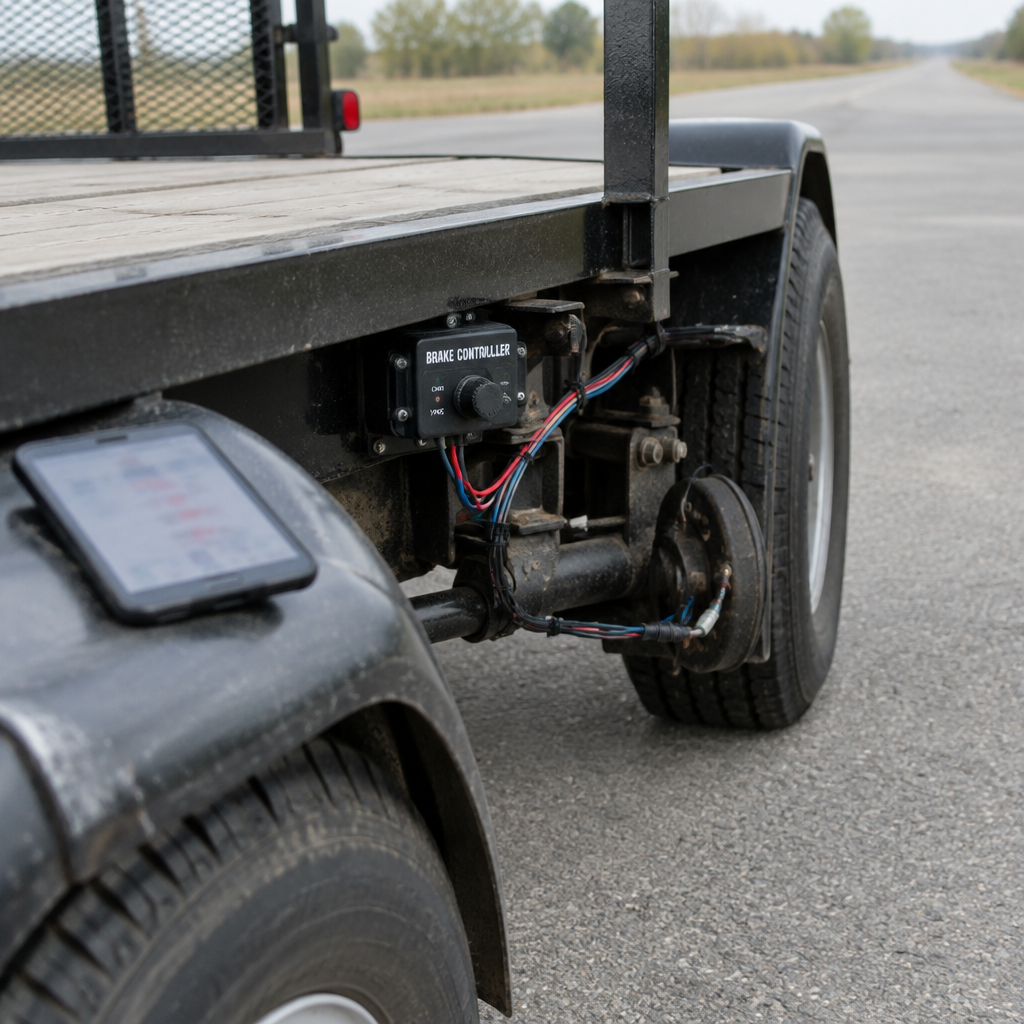
“It had connected mid-drive, without pairing or a prompt, to a brake controller that wasn’t mine, on a trailer I’d never seen, belonging to a driver who had no idea,” researcher Patrick Forck wrote, describing the moment that launched an inquiry which found that anyone within Bluetooth range could potentially command a trailer’s brakes.
How the encounter exposed a design failure
Forck and colleague Jeremy McCarthy, security researchers at Element Digital, began investigating after Forck’s in-car Elecbrakes remote paired to a stranger’s trailer without prompting. Elecbrakes is an Australian manufacturer selling trailer brake controllers in Australia and New Zealand; it offers an in-vehicle controller and a trailer-mounted controller that accepts Bluetooth commands from a smartphone app or a separate in-car remote. The researchers’ on-road observation led them to decompile the Elecbrakes app and map the device’s Bluetooth interface.
Technical findings: the Bluetooth GATT, plaintext commands, and missing safeguards
Using an AI assistant called Claude Code to analyze the decompiled app, the pair reported a full map of the device’s Bluetooth GATT profile: 47 characteristics across four services. Critical braking commands were sent as plain, unencrypted byte arrays with no checksums and no sequence numbers. Other Bluetooth functions required pairing, but crucially “there was no authentication required for critical braking commands,” the researchers wrote.

Audit-ready is a season. It shouldn't be.
Evidence in spreadsheets, controls drifting between audits, frameworks multiplying on flat headcount. Nubivance runs continuous compliance on Rapid7 Cyber GRC - SOC 2, HIPAA, ISO 27001, PCI, CMMC.
End the scrambleProof-of-concept: four bytes, an immediate hum, and unpredictable braking
Forck and McCarthy built a web app that ran in Chrome and accessed Bluetooth controls for a nearby Elecbrakes system. Though pairing failed on some attempts, the connection that mattered—access to the brake control characteristic—succeeded. They report sending “a few bytes to the brake control characteristic” and hearing “the electromagnetic hum at the brake drums” immediately. “It said yes to four bytes from a total stranger then energised several tonnes’ worth of brakes and reported back that it had done so, pleased with itself,” the researchers said.
Further experiments altered braking strength based on deceleration speed, producing unpredictable trailer behavior that depended on how much force a towing driver applied. The researchers summarized the attack succinctly: the attack surface is “anyone within Bluetooth range,” the skill required is “can write four bytes,” and the victim selection is “optional.”
CVE assignments and the role of AI in accelerating analysis
The vulnerability set earned a trio of CVEs from CISA, two of which scored a CVSS of 9.6. The researchers emphasized the speed with which the AI assistant accelerated their work. “This kind of research used to require a fairly rare and specific skill set,” Forck and McCarthy wrote. “It now requires curiosity, a device you own, and an AI that can read bytecode faster than any human.” Their use of Claude Code both generated the GATT map and helped build the proof-of-concept web app.
Elecbrakes’ response and the remaining unpatched unit
Elecbrakes deployed patches for both its in-car and trailer-mounted models; the researchers noted installation is manual and advised owners to stop and install the update. However, a third controller, the ELBC2000, was not patched. That model has not been manufactured in several years and was excluded from the patching process after Elecbrakes did not confirm whether it was vulnerable until the end of October, following pressure from the researchers. As of the researchers’ report, owners of an ELBC2000 should be aware their controller remains vulnerable and no patch is available.
What this means for technologists, drivers, and Elecbrakes owners
- Technologists and security teams: Expect that decompiled apps plus AI-assisted analysis can quickly reveal device GATT profiles and weak command handling; prioritize identifying unauthenticated control paths and adding cryptographic protections where missing.
- Drivers and owners of Elecbrakes controllers: Install the available manual updates for in-car and trailer-mounted models immediately; owners of ELBC2000 units should recognise their device remains unpatched and follow vendor communications for remediation.
- Elecbrakes and similar vendors: Rapid patching for actively manufactured units reduced exposure, but the delayed confirmation about the ELBC2000 left older devices exposed—prompt, comprehensive vendor acknowledgement matters for safety-critical firmware.
The episode is a concrete reminder that adding wireless convenience to safety-critical hardware changes the threat model: in this case, “anyone within Bluetooth range” became the adversary. The researchers demonstrated how little is required—four bytes and a reachable Bluetooth interface—to trigger brakes on a trailer, and CISA’s assignment of high-severity CVEs underlines the risk. For owners, the immediate next step is simple and unambiguous: manually install the vendor’s available updates, and if you own an ELBC2000, treat the unit as vulnerable until Elecbrakes provides a patch or mitigation.