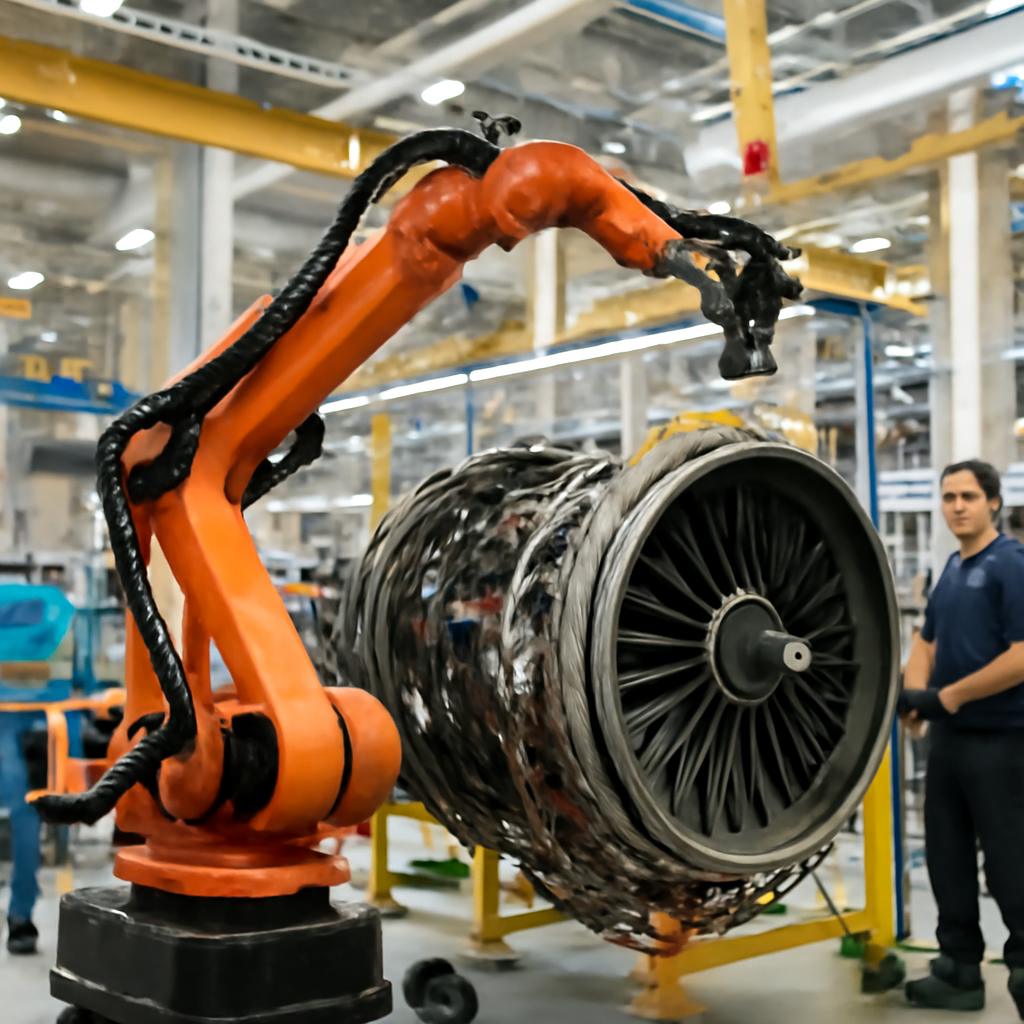
$20 million paid for a long arm and a camera: Pratt & Whitney’s Bearing Automation Robotic Builder — known simply as BARB — is the centerpiece of the company’s first deliberate push to move hard-to-repeat bearing assembly off the bench and onto a robot.
BARB and the 1100G bearing work
On a production line in Middletown, Connecticut, BARB performs assembly tasks for the commercial 1100G geared turbofan, handling the #2 ball bearing and the #5 and #6 rear roller bearings, according to Pratt & Whitney materials and comments from plant staff. Public production and training manuals state the 1100 has seven bearings in total; the #2 supports the front of the low-pressure rotor, which spins above 10,000 RPM. The line assembles the engine in a horizontal orientation.
BARB’s role is to create bearing sub-assemblies — bringing together a bearing, housing components, seals and covers — and to manage thermal fit operations where “you have to heat one part and cool another part” before pressing them together, letting them normalize, and inspecting dimensional tolerances, Ted Sluis, vice president and manager of Product Delivery Centers at Pratt & Whitney, told reporters.
How BARB was taught to see and behave — Ted Sluis on integration
BARB arrived in Middletown “around late 2024,” Sluis said, but only entered production “this spring” after extended trials trained its cameras and sensors to recognize and manipulate production parts. Initial trials used scrap parts, Sluis said, and the robot’s vision system struggled when confronted with new, shiny production components: “The vision system started having issues because it wasn’t used to shiny parts…little things like that, that we had not anticipated.”
Sluis also described deliberate work to integrate the robot’s actions into the engine build record. Where a mechanic traditionally signs each step with a badge to verify prescribed actions were completed in sequence, the current process has mechanics “signing, saying, ‘I provided the parts to the machine, the machine is tracking, I did this, I did this, I did this,’ and that’s going to be part of the engine build record.” The mechanic then signs to acknowledge receipt of the assembly and returns it to the normal process.

The cyber insurance questionnaire just landed. Now what?
SOC 2, HIPAA, insurance renewals - someone has to own security strategy. Nubivance provides fractional CISO leadership without the full-time salary.
Get a security leadOperational results: touch time, yield, and quality signature
Pratt & Whitney describes immediate efficiency gains. Sluis said BARB delivered an 80% reduction in “touch time” for the sub-assemblies it handles. During a July 1 visit, reporters saw the robot actively supervising the heating of parts in an oven while standing by to complete subsequent steps.
Beyond cycle time, the company emphasizes repeatability. Sluis reported the yield of the robot-handled sub-assembly is “essentially 100%,” and that since serial production began there was one issue tied to a part being installed rather than the machine’s work. He framed the “quality signature” from an automated, meticulously trained machine as the principal benefit.
The factory floor still shows human-focused controls: “Foreign Object Debris” bins are posted to remind personnel that stray material — “from stray threads to gum wrappers” — can be catastrophic if ingested by an engine. Pratt & Whitney staff stressed that validating error-free operation across conditions was a prerequisite to broader automation adoption.
AI-assisted borescope inspection and Rob Griffiths’ statement
Pratt & Whitney is pursuing a parallel path of AI-assisted inspection. The company debuted an AI-assisted borescope inspection software for the V2500 commercial engine and completed pilot cycles on both the GTF commercial engines and the F135 military engine, the source reports. The tool applies trained analysis to borescope video “to identify any variations more quickly and consistently.”
Rob Griffiths, senior vice president of Commercial Engines Operations, said in a released statement that broadening AI-assisted inspection “strengthens our ability to detect issues earlier, improve turnaround times, increase time on wing and reduce operational disruption for our customers,” and that the technology “will fundamentally reshape how engines and components are inspected, maintained and supported throughout their lifecycle, as we increase its application across Pratt & Whitney.”
What this means for military customers, mechanics, and production planners
- Military customers: Company executives said military customers have expressed “tremendous interest” in automation for engine assembly. That interest is notable because Pratt & Whitney runs civilian and military lines in parallel, including engines such as the F135 and the F139.
- Mechanics and inspectors: Mechanics remain in the loop for record-keeping and final inspection. Automation reduces touch time but does not eliminate the human responsibility to provide parts, validate machine output, and sign the build records.
- Production planners and facilities teams: Pratt & Whitney has identified its next automation target — the 1100G’s central diffuser module — and is constructing a 2,600-square-foot site to host a robot roughly six times the size of BARB. The company expects a much shorter lead time from delivery to production for the next machine than they experienced with BARB.
Pratt & Whitney’s BARB is a narrow, practical experiment: an expensive, camera-equipped arm handling repeatable sub-assemblies, trained to accept the glare of new parts and integrated into a paper trail that has to be flawless. The company plans to expand to non-rotating modules next, then modules with moving parts, and sees scale depending on “volume, business case or interest,” Sluis said. The near-term test will be whether a larger, faster-deployed robot can match BARB’s “essentially 100%” yield while handling more complex assemblies and working alongside mechanically assembled, vertically oriented engines such as the F135.