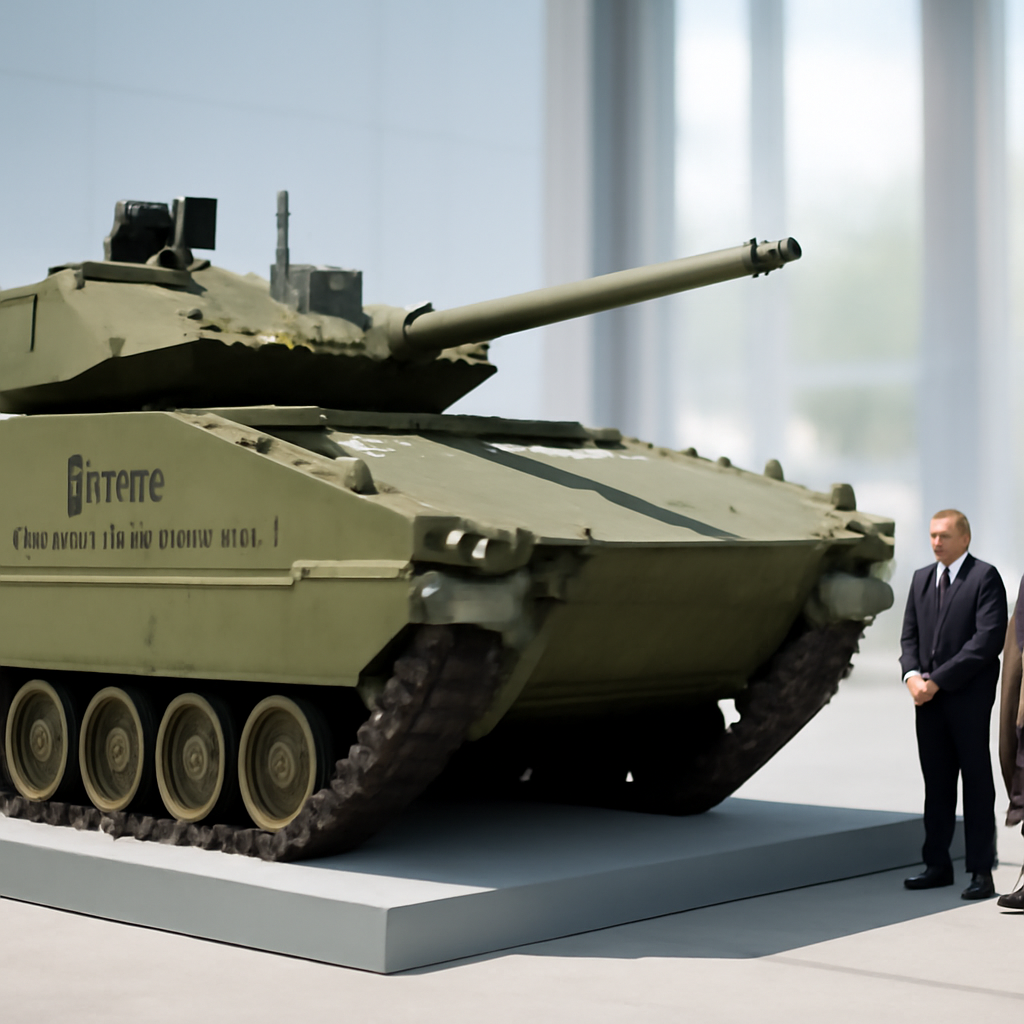
“The demonstrator presented today confirms that Polish companies possess the expertise to design and develop advanced combat platforms that meet the demands of the modern battlefield,” Adam Leszkiewicz, president of PGZ’s management board, said during the unveiling on September 8, 2026.
Huta Stalowa Wola and Polska Grupa Zbrojeniowa unveil the CBWP at MSPO 2026
Huta Stalowa Wola, part of state-owned Polska Grupa Zbrojeniowa (PGZ), presented a full‑size demonstrator of the Ciężki Bojowy Wóz Piechoty (CBWP) — commonly nicknamed Ratel — at the MSPO 34th International Defense Industry Exhibition in Targi Kielce, Poland, on September 8, 2026. PGZ framed the vehicle as a complement to the lighter, amphibious Borsuk IFV and as part of Poland’s wider armored modernization.
Design choices: weight, crew, and tactical role
The CBWP is roughly 40 tons — about 12 tons heavier than the roughly 28‑ton Borsuk — and adds an axle, bringing seven road wheels per side. It is built for a three‑person crew and can carry up to eight infantrymen. PGZ and the vehicle’s designers prioritize protection and battlefield survivability over amphibious ability or the lightness that defined the Borsuk program. The company describes the vehicle’s primary role as transporting troops safely into contested areas and providing direct fire support once the infantry reach their objective.

Audit-ready is a season. It shouldn't be.
Evidence in spreadsheets, controls drifting between audits, frameworks multiplying on flat headcount. Nubivance runs continuous compliance on Rapid7 Cyber GRC - SOC 2, HIPAA, ISO 27001, PCI, CMMC.
End the scrambleProtection suite: ballistic, mine, APS option, OBRA‑3, and NBC
PGZ emphasized survivability as a defining attribute of the CBWP. The demonstrator incorporates advanced ballistic and mine protection designed to meet relevant STANAG standards and uses specialized mine‑resistant seats intended to reduce the effects of explosions under the hull. The protection architecture can be supplemented by an active protection system (APS), which PGZ described as an optional component rather than a specified production fit.
For threat detection, the vehicle can employ laser‑warning equipment including the OBRA‑3 system integrated with smoke grenade launchers; OBRA‑3 has been shown in tests on a Polish Rosomak wheeled armored vehicle producing a smoke screen to blind hostile optics. The CBWP also carries an integrated nuclear, biological, and chemical (NBC) protection system so crew and embarked infantry can operate in contaminated environments.
ZSSW‑30 turret, 30mm programmable ammunition, and Rafael Spike missiles
Firepower on the demonstrator comes from the ZSSW‑30 remotely operated turret. That turret mounts a 30mm cannon capable of firing programmable ammunition and is paired with Rafael Spike anti‑tank guided missiles. PGZ presented this combination as giving the CBWP the ability to engage armored vehicles, infantry, and other battlefield targets, while offering a degree of capability against aerial threats and small drones.
Programmable 30mm rounds provide flexibility against different target types by tailoring projectile effects, while Spike missiles add an extended‑range anti‑armor and indirect‑fire option; PGZ noted Spike’s attributes include the ability to loiter over an area and search for targets. The ZSSW‑30 also contributes to commonality across Poland’s modern armored fleet, already appearing on Borsuk and some Rosomak vehicles.
Testing, production timeline, and procurement numbers
At publication, PGZ had one operational demonstrator intended for factory trials. The company plans to build two fully functional prototypes expected to be ready in 2027; those prototypes will undergo intensive testing with the Polish Armed Forces and could lead to modifications to protection architecture, turret integration, or other elements before a production configuration is finalized. PGZ has indicated the CBWP could be ready for production as early as 2029, but the company cautioned that this is not yet a firm procurement schedule and will depend on test results and customer negotiations.
Poland has been reported to be considering a requirement for up to 700 CBWP vehicles. Separately, Poland has contracted for 257 Borsuk IFVs, with another roughly 1,000 Borsuk‑family combat and specialized vehicles envisioned under a broader framework agreement.
What this means for the Polish Armed Forces, PGZ, and Russia
- Polish Armed Forces: The CBWP is intended to create a two‑tier tracked IFV force in which heavier CBWPs equip units expected to operate in the most dangerous portions of the battlefield, trading amphibious flexibility for survivability where mines, anti‑tank weapons, and drones are significant threats.
- Polska Grupa Zbrojeniowa (PGZ): The demonstrator is a public demonstration of domestic design and production capability; PGZ faces an intensive testing program, possible design changes, and subsequent negotiations with the customer before production decisions are made.
- Russia: The source frames Poland’s armored modernization as driven in large part by the threat posed by Russia, and PGZ’s design choices — heavy protection, APS options, and anti‑armor reach — reflect what Polish planners expect contested operations on the eastern flank to require.
The CBWP demonstrator is a material expression of Poland’s decision to hedge its armored fleet between lighter, amphibious mobility and heavier, more survivable platforms. Whether the vehicle reaches production by the 2029 timeframe PGZ has suggested, and whether Poland proceeds to acquire as many as 700 examples, will turn on the results of prototype testing and the changes those trials produce. For now, the CBWP stands as a statement of capability and intent: heavier armor, layered protection, and a modular weapons fit intended to keep mechanized infantry viable in the increasingly lethal fight.
Source: This Is Poland’s New Heavy Infantry Fighting Vehicle — The Warzone, September 8, 2026