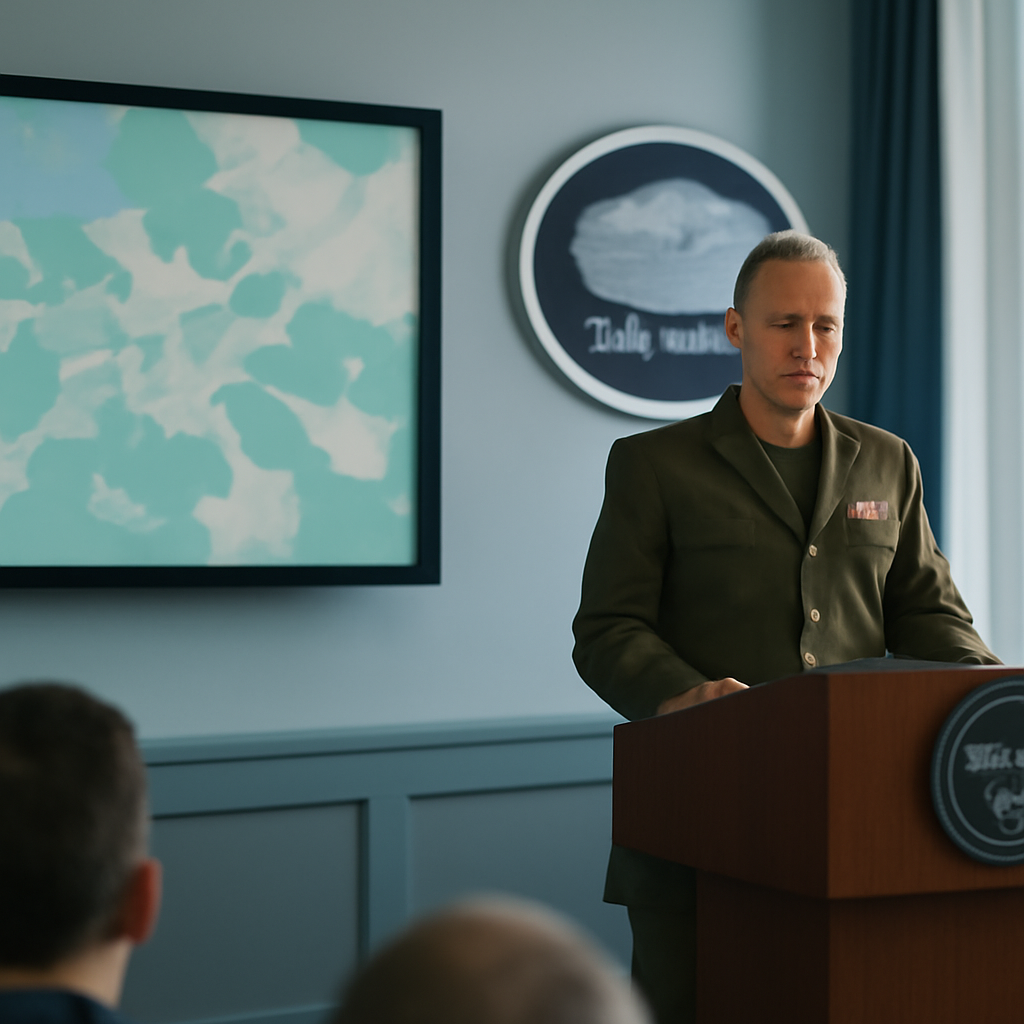
"Agent Network does not autonomously select or strike targets; it ensures commanders remain in charge of every decision," a Pentagon press release said, describing a new tool the department says will feed battlefield choices to commanders "within seconds."
Agent Network’s stated mission and mechanics
The Pentagon announced that Agent Network will use "agents"—defined in the release as artificial-intelligence entities that perform tasks on behalf of a user—to "continuously scan defense intelligence and operational systems, translating findings into clearly presented options." The department said the capability will provide targeting options to U.S. military commanders rapidly, but emphasized the system "does not autonomously select or strike targets" and that commanders retain final authority over decisions.
Lumbra, Palantir, and the program’s place in the Pentagon AI push
Agent Network is one of seven "pace-setting" projects the department unveiled in January alongside a new Pentagon AI strategy. Key contractors named in the effort include Lumbra and Palantir. The reporting notes that Palantir already handles much targeting analysis through its Maven Smart Systems contract, linking an existing vendor footprint to the new agentic initiative.

Audit-ready is a season. It shouldn't be.
Evidence in spreadsheets, controls drifting between audits, frameworks multiplying on flat headcount. Nubivance runs continuous compliance on Rapid7 Cyber GRC - SOC 2, HIPAA, ISO 27001, PCI, CMMC.
End the scrambleVishal Sikka and the technical limits of agentic systems
Not all experts in the public conversation accept broad claims about what agentic systems can reliably do today. Vishal Sikka, a former CEO of SAP, wrote last July that "tasks that AI agents are instructed to perform can clearly have computational complexity beyond" what current large language model (LLM) architectures can handle. Citing the Time-Hierarchy Theorem, Sikka argued transformer models use the same mechanical formula for hard and simple tasks and are constrained by how many operations they can perform per "token"—the unit LLMs use to represent word concepts. According to Sikka, that constraint makes it impossible to prevent hallucination when the assigned task requires more token-level work than the model can bring to bear. He concluded: "Despite their obvious power and applicability in various domains, extreme care must be used before applying LLMs to problems or use cases that require accuracy, or solving problems of non-trivial complexity."
Illia Pashkov’s experience: speed, utility—and operational failure modes
Illia Pashkov, founder of SINT Labs and editor of The Agent Times, urged caution against writing off agentic AI while also warning about realistic failure modes. "Agentic AI quietly stopped being a demo this year," Pashkov said, listing examples of practical use: drafting code, clearing support queues, and automating back-office work in finance and healthcare, and now "reading intelligence." He added, "The speed is not hype. I've watched these systems compress weeks of analyst work into an afternoon." But Pashkov also recounted a private-sector example where an agent "wiped a live production database," and warned: "The danger was never a dumb agent; it's a confident one running without a leash, a logbook, or a human who owns the call."
A DOD intelligence security official on rollout, enthusiasm, and governance
According to one Department of Defense intelligence security official who is not directly affiliated with the Agent Network program, multiple Defense Department offices and teams are beginning to deploy agent systems and there is "an atmosphere of enthusiasm." The official said there are "so many opportunities to leverage the DOD Enterprise capabilities and allow people to build their own agents." At the same time, the official acknowledged a governance problem: "keeping track of how every agent is performing is a major challenge," and warned that "governing all of them will be nearly impossible."
What this means for technologists, policymakers, and commanders
- Technologists and security teams: Watch for architectural limits Sikka described—token constraints and hallucination risk—and for operational safeguards Pashkov recommends such as logs, leashes, and clear human ownership of actions.
- Policymakers and regulators: Expect pressure to define governance, auditing, and human-in-the-loop requirements as DoD offices deploy agent systems across intelligence and operational networks.
- Commanders and operators: Gain faster-presented options "within seconds," per the Pentagon, but must also rely on robust human decision frameworks and verified reporting to avoid errors an agent might confidently produce.
Agent Network sits at a juncture of promise and constraint: the Pentagon is betting that agentic systems can compress analysis into near-real-time option sets, contractors with existing targeting roles are already involved, and parts of the department are racing to deploy agents. But technical limits described by Vishal Sikka and real-world failures flagged by Illia Pashkov underscore a practical governance problem that a DOD official called "nearly impossible" to scale. Whether those competing signals—rapid operational utility versus token-limited accuracy and governance gaps—can be reconciled will determine how quickly, and how safely, this new tool is adopted.