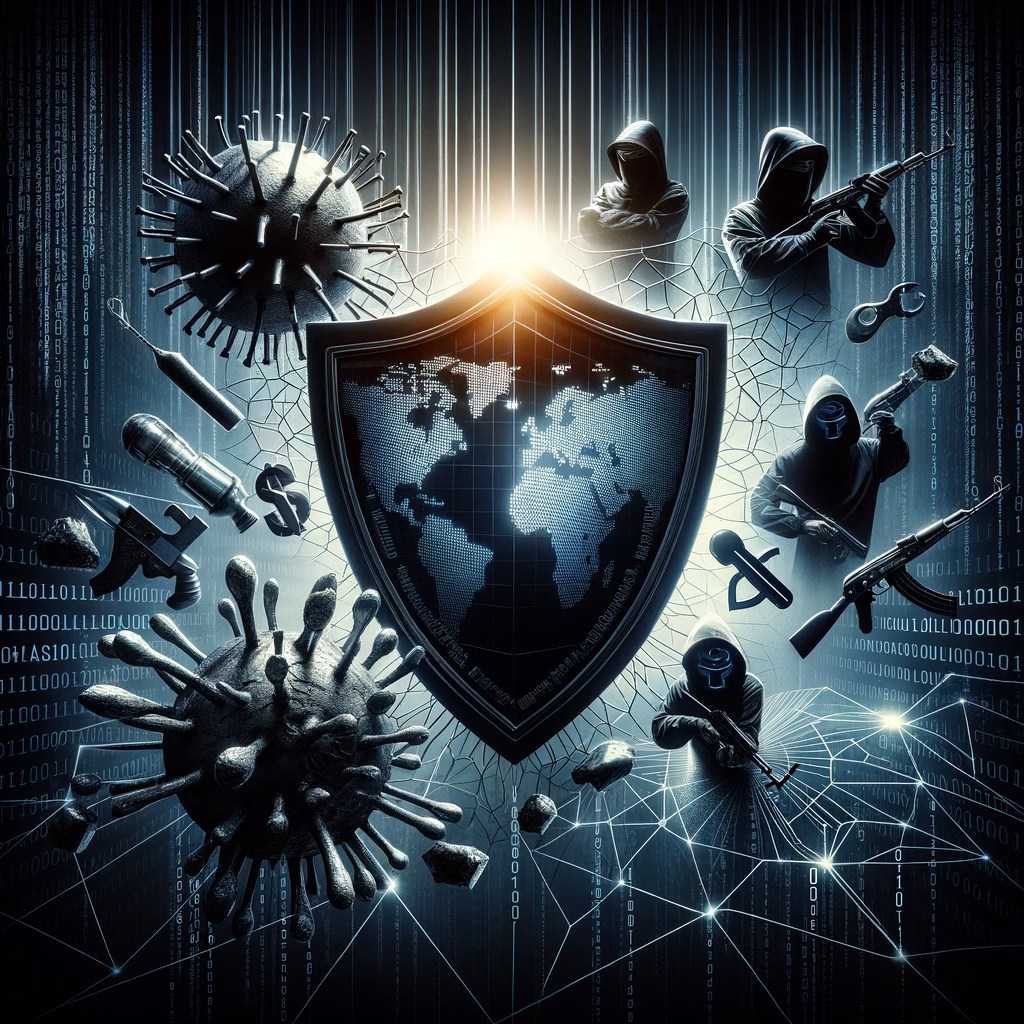
“When the lines of diplomacy blur into lines of code, who decides what counts as an act of war?” That question has gained new urgency this week as analysts traced a covert cyber-espionage campaign to a Pakistan-linked group known as TransparentTribe, which security researchers say has been using a remote-access tool called DeskRAT to penetrate Indian government systems.
Security firms and regional analysts have long kept a wary eye on Pakistan-linked persistent threat clusters. Recent forensic telemetry shows a pattern: targeted spear-phishing, credential harvesting, and bespoke backdoors that give attackers long-term access to sensitive networks. These capabilities are familiar to observers of South Asian cyber campaigns and echo prior intrusions attributed to actors such as APT36, which has focused on Indian defense and government targets in past operations . Independent reporting on similarly scoped campaigns across the region has underscored how stealthy collection operations can run for months before discovery, amplifying the intelligence value of each compromise .
What investigators describe in the TransparentTribe incidents is not a noisy ransomware blitz but a patient, espionage-focused operation. DeskRAT — a remote-access trojan — provides operators with the ability to harvest files, capture keystrokes, and pivot laterally once inside a trusted environment. Those capabilities make it particularly useful for actors seeking diplomatic cables, policy drafts, procurement records, or other material of interest to nation-state intelligence efforts.
How the campaign unfolded, in brief:
- Reconnaissance and social engineering: targeted emails and decoy documents designed to entice officials or staff into opening malicious attachments or enabling remote content.
- Initial compromise: deployment of DeskRAT to establish persistent remote control of infected endpoints.
- Lateral movement and collection: escalation of privileges, harvesting of credentials, and exfiltration of documents and communications.
- Operational tradecraft to evade detection: use of modular tooling and legitimate-looking network traffic to blend with normal activity.
For technologists, the immediate takeaway is practical and familiar: strengthen endpoint detection and response, enforce multi-factor authentication, adopt strict least-privilege policies, and accelerate threat-hunting and log centralization. The technical profile of modern espionage groups favors persistence and stealth over disruption; that means defenders need telemetry that can spot subtle anomalies over long windows rather than only blunt indicators of compromise .
Policymakers face a different calculus. Attribution — even when supported by strong technical leads — is politically fraught. Naming a Pakistan-linked group raises diplomatic stakes between New Delhi and Islamabad at a time when bilateral tensions already run high. Public attribution can deter future operations and justify defensive or retaliatory measures, but it also risks escalation if used without careful corroboration. The pattern of intrusions into government networks highlights a need for clearer norms around state behavior in cyberspace and for bilateral channels that can de‑escalate incidents before they ripple into kinetic or diplomatic confrontation.
For ordinary users — and for the administrative staff who often make inadvertent decisions that expose networks — the campaign is a reminder that nation-state espionage exploits human trust as much as technical flaws. Training, phishing-resistant access controls, and an organizational culture that treats suspicious messages with caution are simple, effective mitigations.
There is also an adversary’s perspective to consider. For operators behind TransparentTribe and similar groups, the choice to favor espionage tools like DeskRAT over destructive malware is strategic: quietly collect intelligence that can inform economic, diplomatic, or military decisions without provoking immediate public outrage. That stealth reduces the political cost of operations and increases their long-term value.
Why this matters beyond headlines: government systems hold policy drafts, negotiation positions, and classified assessments that can alter diplomatic leverage if disclosed. When one side gains a persistent insight into the other’s thinking, it can shape bargaining, influence operations, and military planning. The accumulation of such advantages over time can shift strategic balances without a single missile being fired.
The technical community can point to defenses and the intelligence community to countermeasures, but the underlying dilemma remains political and societal: how to deter espionage in a medium where attribution is difficult, response options are limited, and the costs of miscalculation are high. As observers from multiple firms have noted in coverage of comparable campaigns, the solution set spans better cybersecurity hygiene, more robust international norms, and improved information-sharing among allies and partners .
In the short term, agencies impacted by the TransparentTribe activity should assume compromise where indicators exist, rotate credentials and keys, hunt for lateral movement, and share indicators of compromise with trusted partners so that similar intrusions can be detected and contained elsewhere. In the medium term, governments must clarify red lines in cyberspace and invest in resilient systems that limit the intelligence payoff of successful breaches.
As this episode demonstrates, the invisible contest for information is now a permanent feature of statecraft. The choice for democratic societies is not whether espionage will occur, but how transparently and resiliently they will respond when it does. If a nation cannot protect the integrity of its own policymaking processes, what leverage does it have at the negotiating table?
Source: https://www.infosecurity-magazine.com/news/pakistani-hacker-group-targets/



