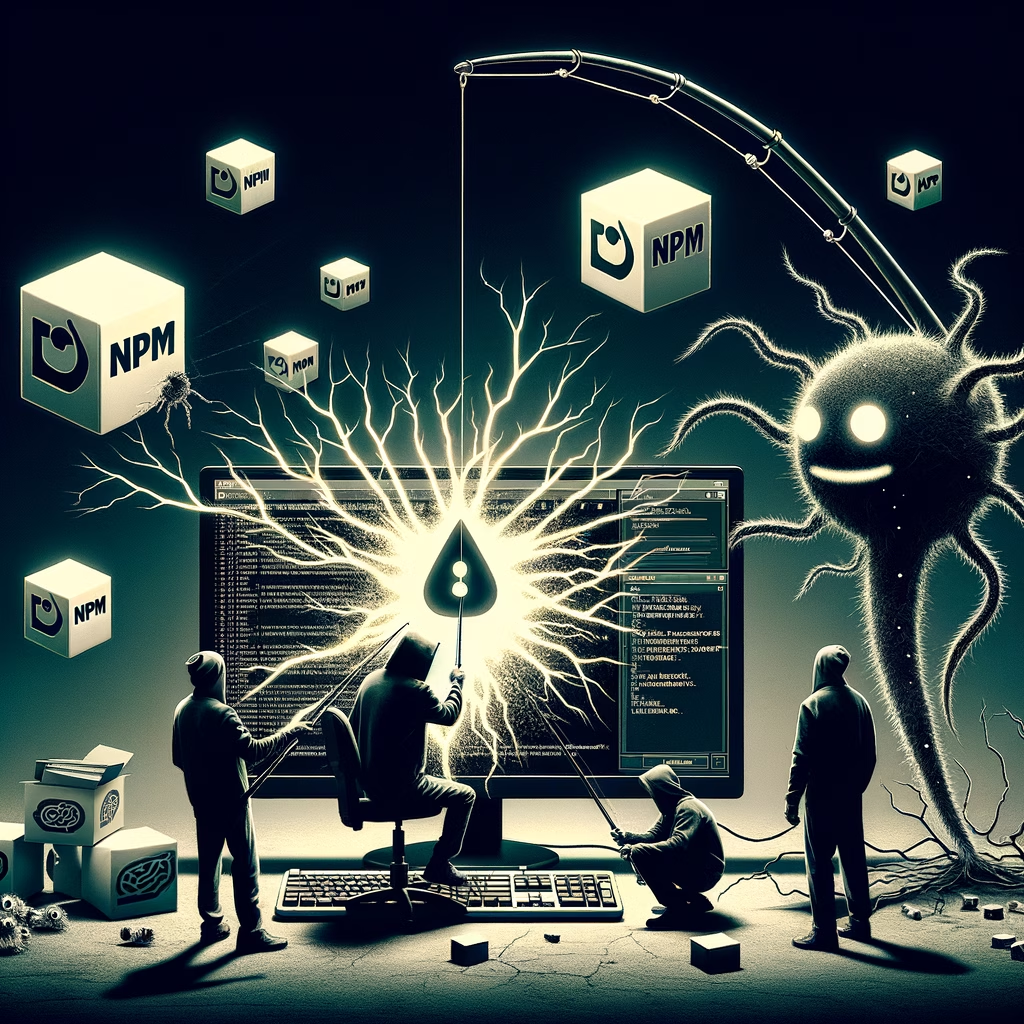
npm package security: Must-Have Alert on Risky Breach
In an era of escalating software complexity, one question is becoming unavoidable for every developer and organization that depends on open-source: how secure are the components you build on? A recent targeted phishing campaign that injected malware into five npm packages has ripped the Band-Aid off fragile assumptions about trust and process in the software supply chain. That incident shows how quickly a single human error can ripple through thousands of projects and reach millions of end-users, underscoring why npm package security must be treated as a first-class engineering concern.
How the attack worked and why npm package security matters
The breach was deceptively simple: attackers used social engineering to steal npm publish tokens from package maintainers. These tokens function like digital keys, granting permission to push new package versions to the npm registry. With a valid token, malicious actors published compromised versions of otherwise legitimate packages—bypassing typical GitHub-based review workflows and hiding their changes from conventional code-review tooling.
This method is especially dangerous for several reasons:
– Scale: A widely used dependency automatically cascades malicious code into thousands of downstream projects through normal dependency resolution.
– Stealth: Attackers can obfuscate payloads, apply time-delays, or check for specific runtime environments, making detection and attribution difficult.
– Broken trust: Developers often assume packages from reputable authors are safe. When that assumption fails, restoring trust is costly and slow.
– Downstream impact: End-users, enterprise systems, and CI/CD pipelines can all ingest malicious code without immediate warning.
Unlike a compromised GitHub account—where code changes are visible in commits and pull requests—a direct npm publish masks provenance. That reduces the effectiveness of traditional review and monitoring techniques and highlights a systemic weakness: many safeguards rely on process and human diligence rather than cryptographic identity and publish-time verification.
Practical defenses for maintainers and teams (npm package security steps)
Improving npm package security requires both individual hygiene and structural changes to tooling and policy. Here’s what maintainers and teams should do today:
– Treat publish tokens like private keys. Rotate tokens regularly and revoke unused ones immediately. Never store tokens in source repositories, public logs, or unsecured CI outputs.
– Use fine-grained tokens and least-privilege access. Prefer tokens scoped to specific packages and limited actions rather than broad, reusable keys.
– Enable two-factor authentication (2FA) and require it for package maintainers. 2FA significantly raises the bar for attackers who rely on credential theft.
– Limit shared accounts. Adopt role-based access controls so responsibility and accountability are clear and auditable.
– Harden CI/CD pipelines. Ensure secrets are vaulted and that build logs never emit sensitive tokens. Add publish-time checks and approval gates for releases.
– Adopt dependency integrity tools. Use automated scanners and supply-chain security solutions to detect unusual package behavior or sudden changes in dependencies.

Audit-ready is a season. It shouldn't be.
Evidence in spreadsheets, controls drifting between audits, frameworks multiplying on flat headcount. Nubivance runs continuous compliance on Rapid7 Cyber GRC - SOC 2, HIPAA, ISO 27001, PCI, CMMC.
End the scrambleRegistry and platform improvements to raise the bar
Registry providers and platform maintainers must build stronger mechanisms for provenance and verification into their services:
– Signed packages and reproducible builds: Cryptographic signing of packages and deterministic build artifacts make it easier to prove who published what and when.
– Publish-time verification: Registries should check for anomalies—unexpected version bumps, odd dependency trees, or publishers using new IPs—and flag or block suspicious publishes pending manual review.
– Auditability and revocation: Make it straightforward to audit publish history, identify affected versions, and swiftly revoke compromised tokens or packages.
– Better alerts and notification channels: When suspicious activity is detected, registries should notify maintainers and downstream consumers with clear remediation steps.
Cultural and organizational shifts to embed security
Technical controls matter, but they must be paired with a cultural shift. Security needs to be baked into developer workflows rather than treated as an afterthought. Practical cultural changes include:
– Integrating threat modeling and supply-chain hygiene into sprint planning and code reviews.
– Making security ownership explicit across teams—not just for a security team, but for maintainers, release engineers, and product owners.
– Running regular drills and incident exercises focused on supply-chain scenarios so teams know how to respond quickly to token compromise or malicious publishes.
Policy and industry roles in improving npm package security
Policy-makers and standards bodies can help by defining baseline requirements for software supply chain security. Standardization can drive adoption of best practices like mandatory package signing, publish logging, and incident reporting norms. While regulation often lags technology, coordinated industry standards can set practical minimums that help elevate the entire ecosystem’s resilience.
Vendors and organizations relying on open source must also insist on transparency and accountability from third-party providers. They should demand disclosure about component provenance and verification processes and adopt internal controls such as dependency whitelisting, automated scanning, and least-privilege policies for CI tokens.
Conclusion: npm package security is a shared responsibility
The phishing attack that altered five npm packages is a stark reminder that well-established open-source ecosystems are not immune to exploitation when human factors and weak controls intersect. Strengthening npm package security requires better token hygiene, stronger registry-side protections, cultural changes in development teams, and thoughtful policy and industry standards. By making security an integral part of how we build, release, and maintain software, we can reduce the chances of similar breaches and protect the integrity of the software supply chain. The integrity of our code depends on treating npm package security not as optional, but as foundational. For deeper reporting and timelines, consult the original coverage on The Hacker News.



