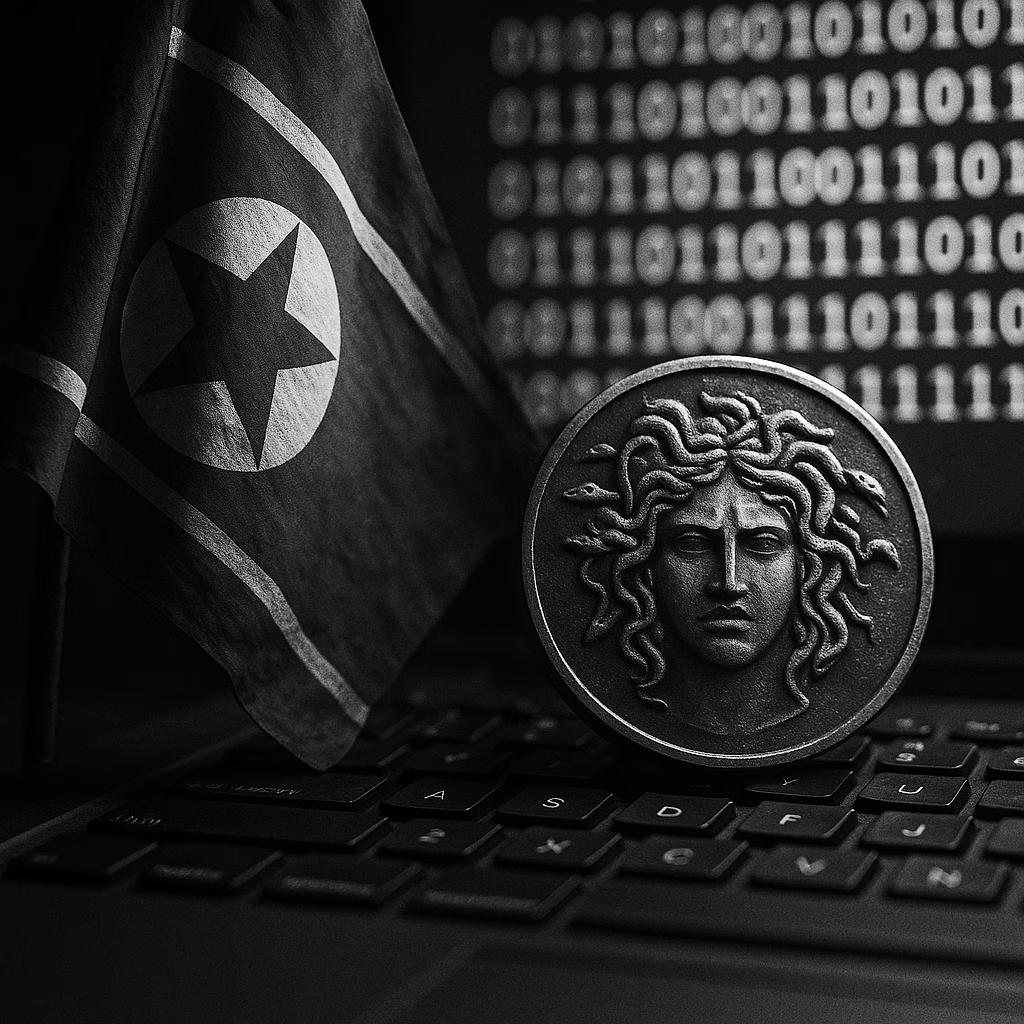
“When a hospital’s doors are open to patients, its networks should not be open to extortion.” Who, then, decides how to lock them? The question now sits at the heart of an escalation in cyberattacks that researchers link to the Lazarus Group of North Korea — most recently through the Medusa ransomware strain — and it lands squarely in the laps of technologists, health‑care administrators and policymakers alike.
Security analysts and incident responders have observed a notable rise in ransomware activity attributed to the Lazarus Group, and researchers warn Medusa has been used to target U.S. health‑care organizations amid an ongoing campaign of intrusions and disruptive attacks. These incidents are not isolated nuisances; they are part of a pattern in which sophisticated nation‑state capabilities are repurposed for criminal gain or applied directly to extract value and cause disruption to critical services .
To understand how we reached this moment requires a brief look backward. Lazarus — a cyber actor long linked to North Korean state interests — has been tied to some of the most consequential intrusions of the last decade, from large-scale thefts of cryptocurrency to destructive malware and high‑profile ransomware campaigns. Over time, researchers have documented the group’s evolution from targeted espionage to financially motivated operations and hybrid campaigns that blend state and criminal objectives .
Medusa, the ransomware strain now flagged in these incidents, is troubling not only for its encryption and extortion mechanics but because of how its deployment fits an expanding playbook: infiltration, lateral movement, data exfiltration, and finally encryption coupled with a ransom demand. When such a sequence touches hospitals, clinics and laboratories the consequences can extend beyond lost files to delayed care, interrupted diagnostics and risks to patient safety — a reality that makes health‑care a uniquely high‑stakes target.
Experts who track supply‑chain and software‑supply threats stress another worrying trend: Lazarus’ toolsets and capabilities are not static. Investigations show code reuse and technique sharing that allow the group’s sophisticated implants to leak into lower‑skill criminal ecosystems, amplifying their reach. As one recent analysis explained, nation‑state grade tooling has been observed turning up in everyday tech‑support scams and other criminal toolkits, producing a dangerous hybrid that is harder to detect and remove .
Why does this matter? Consider three perspectives:
- Technologists: Endpoint detection and response systems tuned for commodity ransomware may miss novel persistence mechanisms or encrypted command‑and‑control channels. The commoditization of advanced implants raises the bar for defensive telemetry and forensics teams, who must now detect both familiar ransomware behaviors and subtler nation‑state techniques .
- Policymakers and regulators: Attribution challenges and the mingling of political and monetary motives complicate responses. Sanctions and indictments have limited impact when code spreads beyond its origin; policy needs to combine diplomatic pressure with incentives for public‑private threat‑sharing and stronger regulatory requirements for critical infrastructure sectors.
- Users and health‑care operators: For administrators juggling budgets and compliance, the decision tree is painful — invest in hardened networks, backups and staff training now, or accept higher risk of operational disruption later. The human cost of delayed care makes that calculus stark.
Practical defensive steps are straightforward in concept though challenging in execution. Security practitioners recommend layered defenses: segmentation of clinical networks, immutable and air‑gapped backups, multifactor authentication, rigorous patch management, and tabletop exercises that reflect ransomware‑and‑exfiltration scenarios. Public‑private threat intelligence sharing and rapid incident reporting are also critical so that indicators of compromise can be quarantined before they become systemic problems .
There are also broader systemic questions. If highly capable toolsets can cascade from state actors into criminal markets, what then of deterrence? Some experts argue for stronger international norms and for targeted disruption of ransomware infrastructure; others point out that unless the economic incentives driving ransomware payoffs are removed — through tougher penalties for ransom payments, improved cyber insurance practices, and greater support for victims — actors will continue to profit from the model.
Hospital administrators and clinical staff are not powerless. Concrete steps that lower immediate risk include restricting administrative privileges, employing network segmentation to isolate critical medical devices, verifying all remote support requests, and maintaining offline backups. For users, the basic hygiene matters: be skeptical of unsolicited support calls, maintain up‑to‑date software, and push for institutional policies that require verification for any remote access to clinical systems.
The threat landscape is clearer now than it was a year ago: Medusa and related activity are symptoms of an adaptive adversary whose tools and tradecraft move across boundaries between state objectives and criminal profit. That mobility demands that defenders, regulators and health‑care operators move faster and more coherently than the adversary.
In the end, the dilemma is this: will we treat cyber‑attacks on health care as inevitable costs of doing business, or will we marshal the resources, regulations and shared intelligence necessary to make those attacks harder, costlier and less effective? The answer will determine not only the security of networks, but the safety of patients who depend on them.
Source: https://www.infosecurity-magazine.com/news/north-korean-lazarus-group-medusa/



