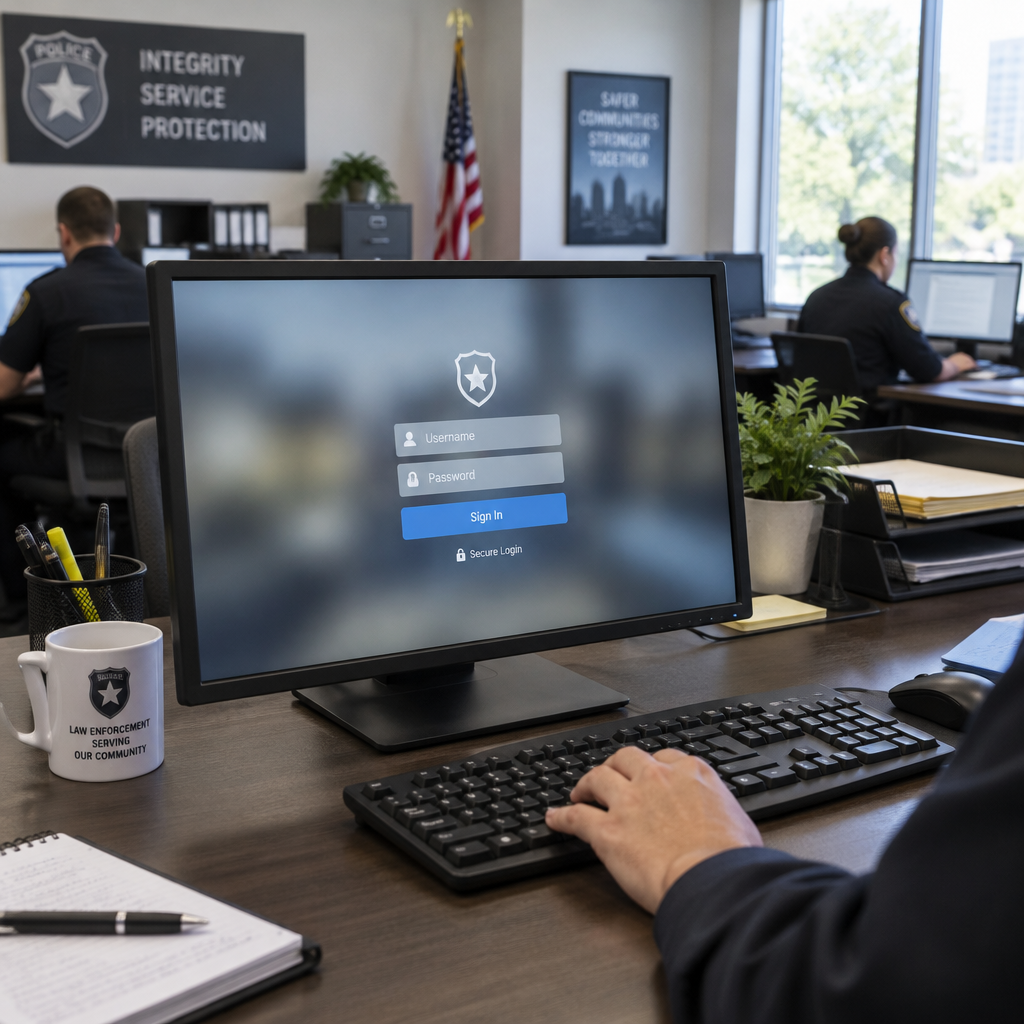
"Stolen credentials are involved in 44.7% of breaches," Verizon found — a blunt statistic that frames why the FBI's CJIS Security Policy treats password and multi‑factor authentication (MFA) controls as Priority 1 measures that “must be implemented immediately.” For law enforcement agencies that handle criminal justice information (CJI), the guidance in a recent Specops Software guide lays out seven practical steps to meet those CJIS requirements and reduce credential-based risk.
CJIS: P1 controls, minimums, and immediate obligations
The CJIS Security Policy, as described in the guide, treats password management and MFA as Priority 1 (P1) controls — controls that must be implemented immediately to achieve compliance. The policy sets a baseline for passwords and for MFA: user-selected passwords must be at least eight characters long (or six characters if they are generated by a credential service provider or verifier using an approved random number generator). CJIS also requires MFA for both privileged and non‑privileged organizational accounts and across local, network, and remote access methods. Finally, CJIS specifies Authenticator Assurance Level 2 (AAL2), meaning two different authentication factors — something you know, have, or are.
Passwords: length, banned lists, and response cadence
The guide urges agencies to move beyond CJIS’ minimums. It recommends encouraging passphrases of at least 15 characters, calling length and strength more important than traditional complexity rules (which CJIS does not require). Agencies must maintain and update a list of commonly used, predictable, and compromised passwords — including breached passwords, dictionary words, sequential patterns, and context‑specific terms such as usernames or agency names — and CJIS requires that list be updated at least quarterly and whenever organizational passwords are suspected of being compromised.

This site is the portfolio.
OSINTSights runs on Cloudflare Workers, D1, R2, and Vectorize, with an AI pipeline on Hetzner ARM. Nubivance designed, built, and operates it. We do the same for clients.
See what we buildDetecting compromise and improving user experience
CJIS requires agencies to force a password change when there is evidence a credential has been compromised, and to require users to select a new password immediately whenever compromise is suspected. The guide recommends checking existing passwords against breach lists at least quarterly and more often when possible. It also highlights the operational benefit of giving users clear, real‑time feedback during password creation or reset so they understand why a password is weak and how to improve it — reducing help‑desk load and user frustration.
MFA: scope, methods, and phishing resistance
The policy requires MFA for all accounts that touch CJI, not just administrators. Agencies should ensure MFA covers Windows logons, RDP, VPN connections, and remote access points, and should extend protection to SaaS applications via single sign‑on where supported. The guide notes that solutions can integrate SSO for compatible SaaS apps through OIDC and SAML. It reiterates the CJIS AAL2 requirement (two different factor types) and explicitly recommends, where possible, using phishing‑resistant MFA methods to blunt credential‑phishing and adversary‑in‑the‑middle attacks.
Transport, storage, and continuous auditing
CJIS requires passwords to be transmitted over encrypted, authenticated channels to prevent interception, and when stored to be salted and hashed with a suitable one‑way key derivation function so offline cracking is more difficult if an authentication database is exposed. The guide stresses that compliance is not a one‑time project: agencies should regularly review authentication controls, check for compromised credentials, and audit Active Directory. It points to a free, read‑only AD audit offered by Specops Password Auditor that checks for weak or compromised passwords and inactive privileged administrator accounts and delivers an interactive report.
How law enforcement IT teams, procurement leaders, and end users will respond
- Law enforcement IT and security teams: they must inventory where CJI is touched, extend MFA across local, network and remote access, run compromise checks at least quarterly, force immediate resets on suspected compromises, and ensure transport/storage protections (encrypted channels; salted, hashed credentials).
- Procurement and technology leaders: they will evaluate products that claim continuous breached‑password screening and CJIS‑aligned templates — the guide highlights Specops Password Policy with Breached Password Protection (continuous screening against a database the guide says is “more than six billion” compromised passwords) and Specops Secure Access for Windows logons, RDP, and VPN, plus SSO via OIDC/SAML.
- Individual users and contractors: expect to be required to use longer passphrases (the guide recommends at least 15 characters), enroll in MFA for all accounts, receive immediate prompts to change passwords when compromise is suspected, and see real‑time feedback when creating stronger credentials.
Compliance under CJIS is framed in the guide as both prescriptive and operational: follow the P1 controls now, but also build ongoing processes — quarterly breach list updates, automated compromised‑password screening, encrypted transport, salted and hashed storage, and regular AD audits — to keep authentication controls effective. The guide closes with a practical sales route — book a demo to see how Specops solutions can help — but the technical imperatives it lays out are clear: longer, screened passwords; universal MFA that meets AAL2; encrypted transport and secure storage; and continuous auditing.