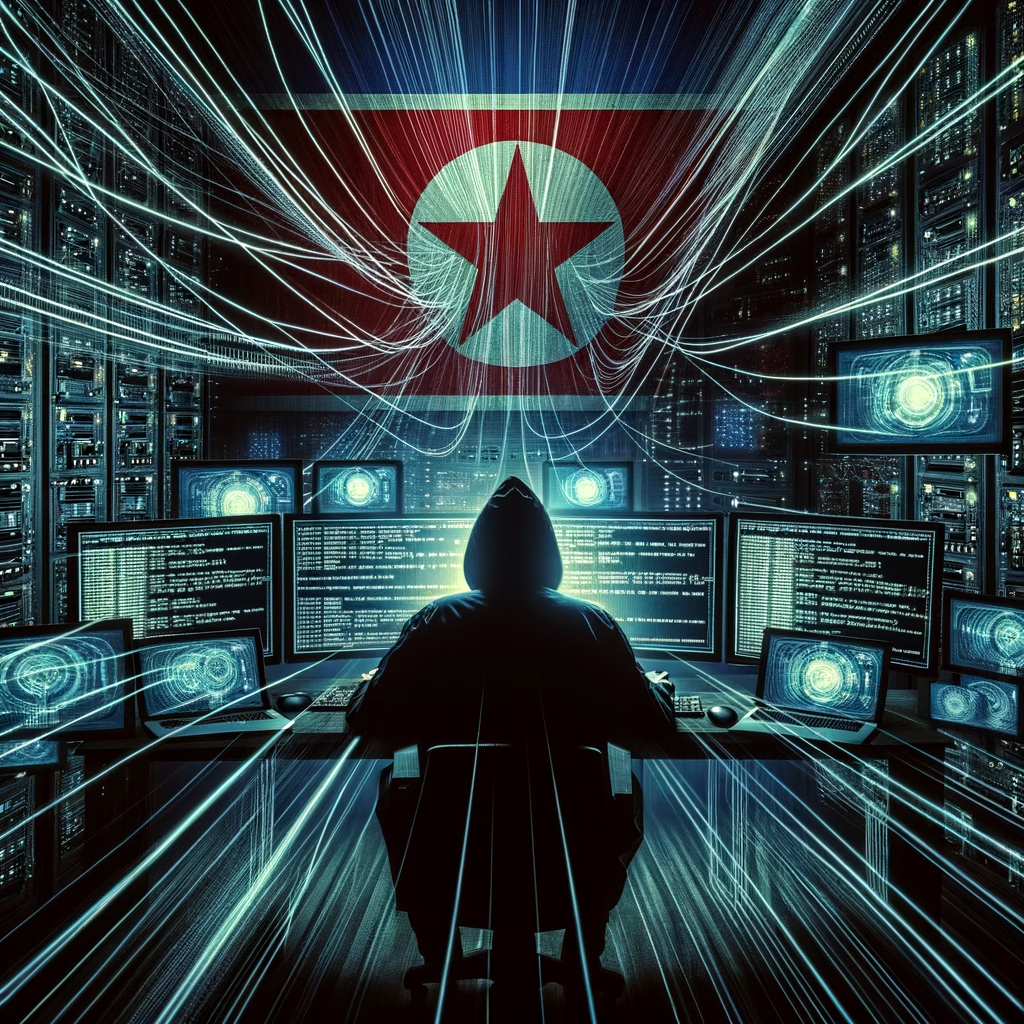
“How do you defend a world where the paper trail is code and the code hides the bullet?” That is the dilemma facing software engineers and security teams today, as a persistent North Korean threat group—tracked under names such as Contagious Interview—refines a low-noise, high-impact technique: staging malicious payloads on innocuous JSON storage services and then pulling them into trojanized code projects. Researchers at NVISO have documented this shift, noting the group’s recent use of platforms like JSON Keeper, JSONsilo, and npoint.io to host and deliver malware.
This is not theater; it is methodical adaptation. Over the past year investigators have observed a string of campaigns aimed not merely at endpoints but at the supply chains and developer workflows that produce the software we all rely on. In some cases, attackers have slipped malicious packages into public registries and seeded developer environments with backdoors that lie dormant until they are consumed by build systems or developer machines. Security firms and analysts have tied these behaviors to the Contagious Interview operation and related North Korea–linked campaigns that pursue stealth, persistence, and strategic access rather than noisy theft.
Why JSON storage services? They are attractive to attackers for a simple reason: trust and convenience. Services such as JSON Keeper, JSONsilo, and npoint.io are designed to store and serve small snippets of structured data—configuration files, snippets, or sample payloads—often without strong authentication, and with publicly accessible endpoints. By hosting code fragments, encoded payloads, or configuration directives on these platforms, an adversary can:
- deliver malicious content to victim environments without hosting their own infrastructure, reducing attribution risk;
- hide within legitimate-looking requests to benign services, blending into normal developer traffic; and
- rapidly change payloads by editing a single JSON document, enabling agile updates and evasive maneuvers that frustrate static detection.
These operational advantages were illustrated in recent reporting on related supply-chain intrusions, where North Korea–linked actors inserted malicious packages into widely used repositories and planted modular backdoors in developer environments. Those incidents underscore a broader adversary strategy: compromise the tools that produce trusted software rather than relying solely on brute-force intrusions into production networks .
Technologists see the change as an escalation in tradecraft. Instead of attacking the largest, best-defended targets directly, sophisticated actors now weaponize the convenience layers—package managers, configuration services, and ephemeral storage—that accelerate modern development. Defenders must therefore move beyond perimeter thinking. Recommended mitigations include rigorous supply-chain hygiene (dependency pinning, reproducible builds, artifact signing), better monitoring of developer endpoints, and network controls that restrict retrieval of remote configuration and code snippets to vetted sources. Security teams should also instrument CI/CD pipelines to detect when build-time artifacts pull remote JSON or other external payloads unexpectedly.
From a policy perspective, the technique raises difficult questions about responsibility and control. Many JSON storage providers are small services with limited staff and narrow terms of service; they are not built to be gatekeepers for code delivery. Policymakers can push for industry standards—basic authentication defaults, abuse-reporting mechanisms, and transparency tooling—but heavy-handed regulation risks breaking legitimate developer workflows. Internationally, attribution to state-aligned actors complicates response options: sanctions, cyber countermeasures, or coordinated disclosures each carry geopolitical cost.
For everyday users and developers the practical takeaway is simple and uncomfortable: assume that code and configuration obtained from external sources may be hostile. Enforce multi-factor authentication, rotate keys, minimize the privileges of developer machines, and treat third-party snippets as untrusted input until validated. Education and threat-aware development practices—such as the principle of least privilege for build agents—are immediate, low-cost defenses.
What of the adversary? For North Korean operators, the calculus is clear: patience and precision yield outsized returns. A single, well-placed trojanized package or a stealthy backdoor in a popular developer tool can ripple outward, affecting downstream projects and, ultimately, end users. Prior campaigns have demonstrated that these groups value long-term access to intellectual property, cryptocurrency infrastructure, and the capabilities to manipulate software artifacts at scale, consistent with state-directed priorities for revenue generation and intelligence collection .
The contours of this threat point to a sobering reality: convenience in software development is also an attack surface. The practice of hosting active payloads in public JSON stores is clever precisely because it exploits trust baked into modern toolchains. The technical community can blunt that tactic, but doing so requires coordinated effort—better tooling, clearer standards, and sustained attention to developer security habits.
In an era when a few lines of JSON can open a door to a nation-state actor, the question is not whether we can stop every intrusion; it is whether we will reorganize incentives so that security becomes an integral part of how code is written and shared. If the recent use of JSON storage by Contagious Interview teaches us anything, it is that our defenses must travel upstream—into the developer workflows and cloud services that shape everything we build.
Source: https://thehackernews.com/2025/11/north-korean-hackers-turn-json-services.html



