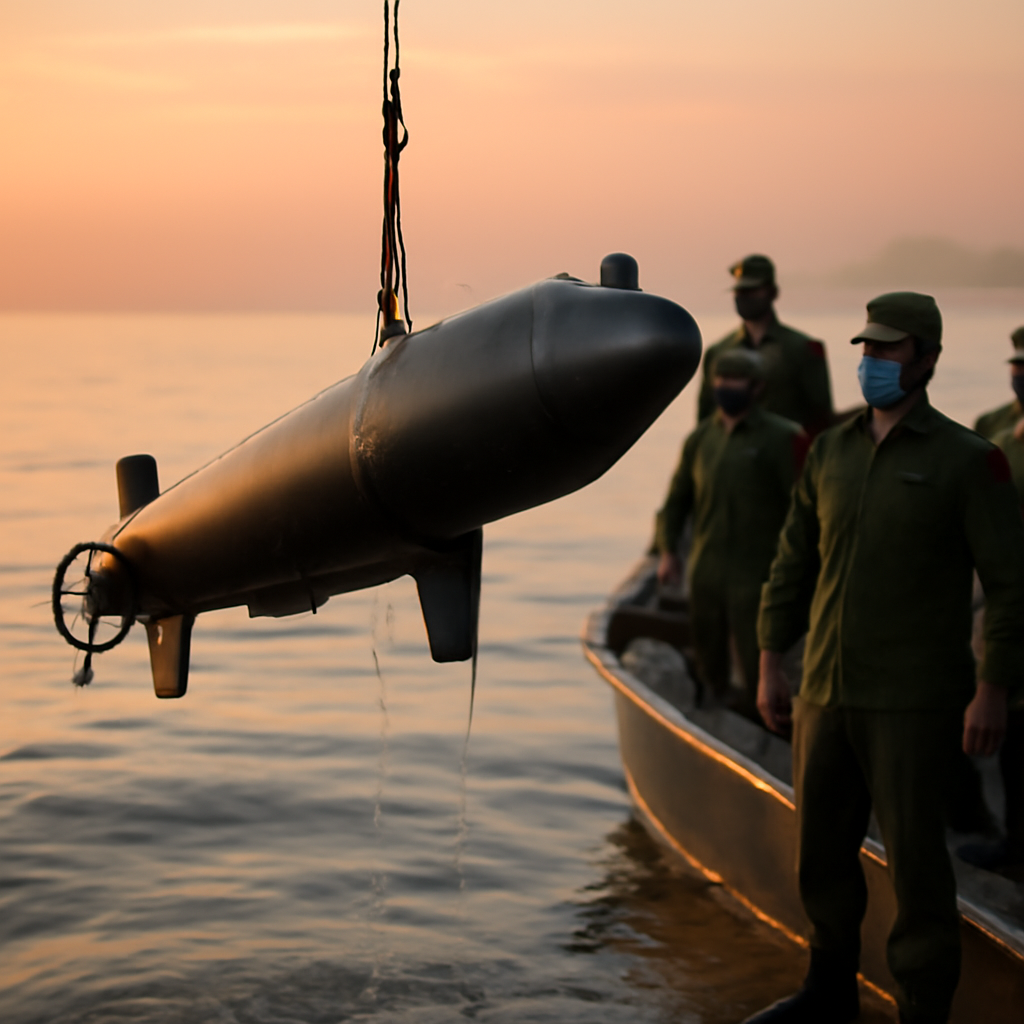
"captured one of the most modern, unmanned, and smart submarines … at the entrance to the Strait of Hormuz in a complex intelligence and operational action at dawn today," the Islamic Revolutionary Guard Corps said via Iranian state media.
What Iran showed and what it claims
Iranian authorities released pictures and short video clips showing a submersible being hoisted from the water and displayed at several points below the surface. Tehran’s state-aligned outlets identified the vehicle as a U.S. Dive-LD uncrewed underwater vehicle (UUV) recovered “largely intact” near the Strait of Hormuz. The Islamic Revolutionary Guard Corps (IRGC) framed the retrieval as a planned intelligence-and-operational action conducted “at dawn.”
U.S. officials’ account and Anduril’s statement
A U.S. official told reporters that “an underwater drone operated by U.S. forces malfunctioned more than a day ago” while “surveying regional waters in support of ongoing operations.” The same official said the “defective drone was an older model that neither collected sensitive data nor carried any classified sonar or radar equipment,” adding, “U.S. operations in area waters continue.”
Anduril, which acquired Dive Technologies in 2022, confirmed the loss of a Dive-LD operating in the region. An Anduril spokesperson described Dive-LD as “an attritable autonomous system, meaning it is designed from the outset to operate in dangerous environments where loss of the vehicle is an expected possibility,” and said the vehicle “had already delivered significant value operating thousands of hours in months-long operations in CENTCOM.”

Audit-ready is a season. It shouldn't be.
Evidence in spreadsheets, controls drifting between audits, frameworks multiplying on flat headcount. Nubivance runs continuous compliance on Rapid7 Cyber GRC - SOC 2, HIPAA, ISO 27001, PCI, CMMC.
End the scrambleDive-LD: size, endurance, and modular missions
The Dive-LD is categorized as a large UUV: about 19 feet (roughly 5.8 meters) long, four feet (about 1.2 meters) in diameter, and with a gross weight close to three tons. Its exterior uses 3D-printed components and it is rated to dive to depths of about 19,685 feet (3.7 miles or 6,000 meters). Depending on configuration, Dive-LDs can remain at sea for roughly 10 days and operate with a high degree of autonomy.
Anduril’s materials and public reporting list a highly modular design able to support intelligence preparation of the operational environment (IPOE), general intelligence, surveillance, and reconnaissance (ISR), mine warfare, and precision placement of objects underwater. The platform entered U.S. Navy service after Anduril delivered the first unit to Unmanned Undersea Vehicle Group One (UUVGRU‑1) in April 2025; the Navy had already released imagery of personnel training with a Dive-LD in late 2024 and personnel from UUVGRU‑1 and UUVRON‑3 trained with the system in December 2024. Chief of Naval Operations Adm. Daryl Caudle was shown a Dive-LD during a visit to Naval Base Kitsap‑Keyport in June 2026.
How Dive-LDs have been used around the Strait of Hormuz
U.S. officials have previously said UUVs are supporting mine‑clearance operations in and around the Strait of Hormuz. Uncrewed underwater platforms are used to locate and record naval mines with sonars, cameras, and other sensors, keeping human forces farther from direct mine hazards. A recent Financial Times account — cited in the reporting — described U.S. forces using UUVs, robot boats and divers over a multi‑month mine‑clearance mission, and named the Common Uncrewed Surface Vessel (CUSV) as a speedboat‑sized drone used for counter‑mine work.
Forward-deployed mine‑configured Independence‑class Littoral Combat Ships had been in Bahrain before the conflict with Iran and two of those ships, USS Santa Fe and USS Tulsa, were reported in March as later appearing in Southeast Asia; at the time of reporting those ships were in Singapore. The third, USS Canberra, was reported to be sailing in the South China Sea. The reporting notes Dive-LD’s 10‑day endurance could allow launch from locations away from the Strait, including friendly ports, and that Dive-LDs could support IPOE and ISR tasks beyond mine clearance, including seafloor surveys to keep alternate transit routes — such as those hugging the Omani coast — safe for commercial traffic.
What this means for Iran, U.S. naval forces, and Anduril
- For Iran: The regime has historically collected foreign military hardware and has said it will analyze and attempt to reverse engineer recovered systems. Tehran may exploit the recovery for technical analysis, internal propaganda, and potential sharing of material with foreign partners.
- For U.S. naval forces: The loss underscores the operational risks of deploying uncrewed maritime platforms in contested waters; the U.S. official described the vehicle as malfunctioning and not carrying classified sonar or radar, but the vehicle’s intact recovery suggests U.S. forces had lost situational awareness of its location prior to Iranian retrieval.
- For Anduril: The company emphasized Dive-LD’s attritable design and reported thousands of operational hours in CENTCOM; the incident highlights both the platform’s operational tempo and the tradeoffs inherent in fielding systems built to operate in high‑risk environments.
The seizure is the latest example of foreign forces taking intact Western unmanned systems; reporting recalls Iran’s 2011 capture of an RQ‑170 Sentinel and earlier incidents in August 2022 when the IRGC attempted to seize a Saildrone and briefly commandeered a pair of American Saildrones in the Red Sea. The reporting leaves open what, if any, recovery attempts U.S. forces made and how Iran will exploit the Dive‑LD technically or politically.
https://www.twz.com/sea/everything-we-know-about-the-u-s-navys-submersible-drone-iran-just-captured