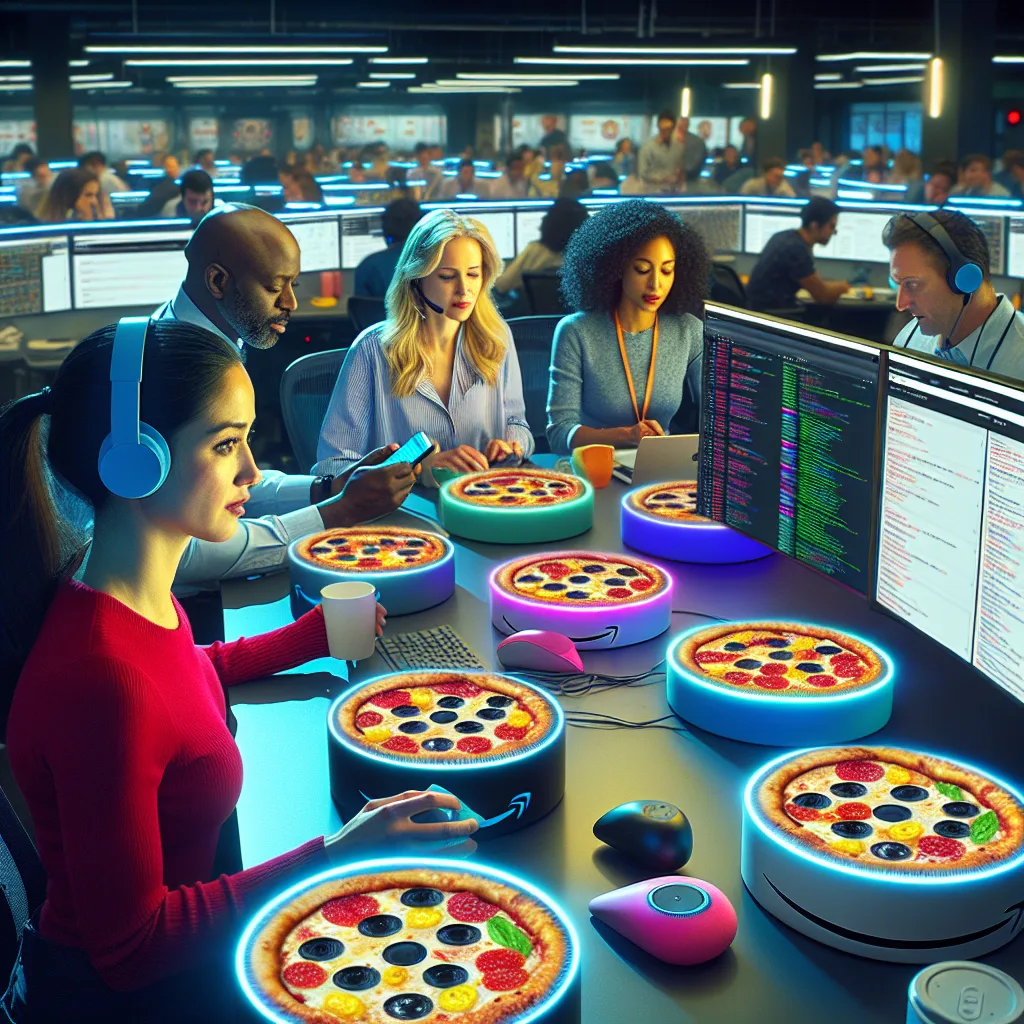
Inside Amazon’s Red Team Strategy: Preventing Teens from Hijacking Alexa for Unintended Purchases
In a world increasingly reliant on voice-activated personal assistants, a recent deep dive into Amazon’s Red Team operations has revealed an unconventional focus: preventing mischievous teenagers from placing extravagant orders via Alexa. At the RSA Conference (RSAC), industry experts and security professionals were given a rare glimpse at the internal safeguards Amazon has meticulously engineered. The stakes? Ensuring that Alexa’s ease of use does not inadvertently open doors for unintended or even hazardous behavior, such as a child ordering 50 pizzas or, worse yet, triggering home automation mishaps that could lead to safety concerns.
Amazon’s Alexa, already a staple in countless households worldwide, is designed to simplify daily tasks. Yet it has also attracted attention from those eager to explore its limitations—from critics questioning user privacy to pranksters testing its boundaries. The recent red team exercise illustrates a proactive approach to what might seem like a niche concern at first glance, but one that encapsulates broader challenges inherent in integrating artificial intelligence (AI) into everyday life.
Historically, personal assistants like Alexa were developed with a focus on convenience: voice commands to play music, set reminders, or control smart devices in the home. However, as these tools have advanced, so too have the complexities of ensuring that they operate safely under all conditions. This is particularly pressing when the service is extended to tasks that involve financial transactions or interfacing with third-party vendors, as even a small oversight in authentication or command processing may result in unintended purchases or, in a worst-case scenario, compromised household safety.
Amazon’s strategy, as shared during sessions at RSAC, is built on an internal “red team” approach—essentially an in-house group tasked with thinking like potential adversaries. Their goal is not only to identify vulnerabilities in Alexa’s systems, such as preventing a teenager from ordering an excessive amount of pizza, but also to develop comprehensive response protocols for a variety of use-case scenarios. This red team does not merely look for how to break the system; it simulates realistic interference, evaluates the quality of each safeguard, and collaborates with the design teams to refine Alexa’s response mechanisms.
Current demonstrations provided at RSAC unveiled a scenario that might appear humorous at first: a playful teen commanding Alexa to order an unprecedented number of pizzas. Yet beneath the levity lay a critical test of system limits. During controlled tests, the red team observed that without layered authentication and context-aware analysis, Alexa could inadvertently process orders that defied typical consumer behavior. Such an incident does not only have monetary implications but also risks entanglement with other smart home functions, such as controlling an oven, which if left unchecked, might convert a trivial mistake into a severe safety hazard.
These exercises demonstrate Amazon’s intent to preemptively address potential misuse before vulnerabilities become mainstream public relations or regulatory nightmares. The integration of safeguards like multiple voice recognition steps, context validation, and alarm triggers during anomalous behavior form part of a broader defensive strategy designed to transform Alexa from a convenience tool into a robust, secure, and responsible assistant.
Why does this matter on a wider scale? The evolution of AI-driven household assistants is not merely a technological advancement—it’s a transformation in the way human households interact with technology. Incidents where a system is hijacked, even by a mischievous or curious teen, highlight significant risks. Beyond the inconvenience of unintended purchases, such breaches could erode public trust in emerging AI technologies. For instance, if voice-activated commands start inadvertently interfacing with critical household systems, from smart ovens to home security networks, there exists a genuine risk of creating environments ripe for both accidental harm and malicious exploitation.
Security experts emphasize that what might seem like isolated incidents are often symptomatic of broader vulnerabilities. David Mouser, Global Head of Information Security at a longstanding financial institution, has noted in several industry publications that “the digital ecosystem’s interconnectivity can turn small errors into widespread crises.” While Mr. Mouser’s insights have traditionally targeted banking and financial systems, his observations are equally relevant when considering the smart homes of today, where AI devices operate as both gateways and guardians.
The red team insights from Amazon reaffirm an emerging narrative: with every new technological leap comes an imperative to rethink the boundaries of safety and security. This situation could be compared to early days in aviation, where new methods of flight revolutionized travel but simultaneously presented unforeseen challenges in ensuring passenger safety. In a similar vein, ensuring that a system like Alexa behaves appropriately requires not just cutting-edge technology, but also robust testing, deep analysis, and a willingness to confront inconvenient scenarios head-on.
Beyond Amazon’s internal protocols, the broader technology ecosystem stands to learn from this approach. Other companies in the tech sphere, particularly those developing personal assistants and connected home devices, have begun adopting rigorous red team exercises to parse potential vulnerabilities. This push to democratize security best practices could help form a unified standard across the industry focused on user experience and safety simultaneously.
One significant advantage of these red team exercises is their interdisciplinary nature. They draw on principles from cybersecurity, behavioral science, and even product design, bridging theoretical research with on-the-ground testing. This is a critical juncture where innovation meets risk management, requiring teams to evaluate both technical defenses and the human interactions that drive misuse or errors. The balancing act is complex: every safeguard introduced must be weighed against potential friction points in the user experience.
Several key measures emerging from Amazon’s red team strategy include:
- Voice Authentication: Introducing multi-layered voice recognition to ensure that commands originate from legitimate users, thereby differentiating between genuine requests and potentially impetuous commands from unauthorized parties.
- Context-Aware Processing: Designing algorithms that assess the plausibility of commands in context. For example, ordering 50 pizzas outside of regular meal planning scenarios prompts a verification step.
- Integrated Safety Protocols: Coordinating with other smart home systems to prevent hazardous outcomes. If Alexa detects a possibility of a dangerous action—such as turning on an oven while an order is being processed—it can temporarily interrupt processes and seek confirmation.
These targeted measures indicate that the focus is not only on preventing financial misadventures but also on shielding users from potential hazards that could arise from a glitch in interconnected systems.
Industry observers remain cautiously optimistic about these developments. John McAfee, a noted technologist and cybersecurity commentator, has often stressed the importance of layered security. While he has receded somewhat from active commentary in recent years, his longstanding advocacy for robust security measures lends weight to the argument that companies like Amazon must continue to innovate defensively even as they push the envelope of AI integration. His calls for clear, context-sensitive safeguards echo throughout the red team strategy showcased at RSAC.
Looking ahead, the interplay between AI convenience and digital security promises to be a defining narrative for the remainder of this decade. As voice-activated assistants integrate with more household functions, the potential for cross-system interference grows, reinforcing the need for relentless testing and improvement. Future innovations may include even tighter integration between hardware controls, biometric verification, and real-time behavioral analytics to ensure that a single misinterpreted command does not cascade through multiple systems.
For policymakers, the developments at Amazon also serve as a cautionary tale. As lawmakers around the world grapple with regulating emerging technologies, ensuring that consumer devices operate within safe parameters is paramount. Regulatory bodies like the Federal Trade Commission in the United States and similar agencies in Europe will likely monitor how companies balance user convenience with the innate risks of automation. While there is a growing appetite for innovation, the mandate for safety and accountability remains non-negotiable.
From an economic perspective, incidents of system misuse—even when they appear trivial—can have outsized impacts on public trust. A single, highly publicized case of a voice assistant inadvertently triggering a home hazard or executing an absurd purchase may trigger consumer pushback and could even influence stock prices. Investors, increasingly attuned to reputational risk in technology companies, are watching closely. The measures Amazon has instituted not only safeguard users but also help maintain investor confidence in the broader promise of smart home technology.
As we transition to a future where everyday household routines blend seamlessly with AI-driven automation, the fundamental challenge remains ensuring that convenience does not come at the cost of security. In this cautious era of innovation, where a command to order pizza could inadvertently involve the activation of an appliance, each safeguard is critical. Amazon’s red team strategy underscores a central truth: in a world where technology acts as both servant and gatekeeper, constant vigilance and rigorous testing are essential.
In the final analysis, Amazon’s red team initiative is more than a series of internal tests. It is an emblem of an industry-wide shift—a recognition that the path toward seamless, intelligent automation must be paved with robust countermeasures and forward-thinking design. As we move forward, both industry innovators and consumers alike would do well to ponder the delicate balance between ease of use and uncompromised safety. After all, in a landscape where your next command could unlock hundreds of unintended consequences, isn’t it reassuring to know that someone is already thinking one step ahead?



