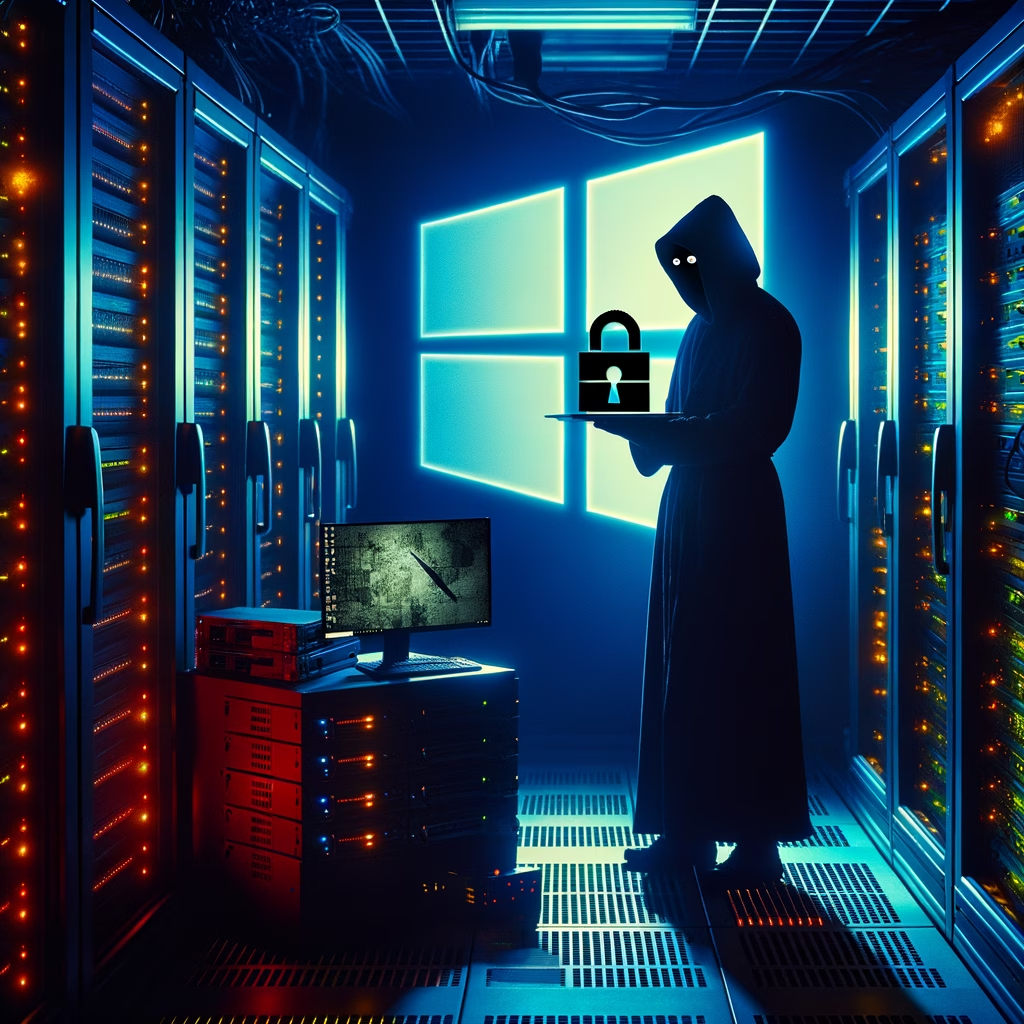
Curly COMrades — what happens when a spycraft trick that once lived in fiction quietly moves into enterprise data centers and desktop PCs? “If an adversary can run an entire Linux virtual machine under Hyper‑V on a compromised Windows host, they’ve just bought themselves a shadow operating system,” said one senior threat hunter who asked not to be named. The dilemma is simple and stark: defenders may be watching Windows, but an attacker running a hidden Alpine Linux VM inside Hyper‑V can look right past most endpoint tools.
Curly COMrades are the actors behind a new technique that abuses Microsoft’s Hyper‑V hypervisor on compromised Windows machines to spawn an Alpine Linux–based virtual machine. The VM operates beneath the usual Windows security telemetry, enabling long‑term, stealthy access for espionage — data collection, credential harvesting, lateral movement and the deployment of additional malware — without tripping the alarms defenders expect.
H2: Curly COMrades and the hidden Hyper‑V VM — what we know
– The operation uses legitimate Hyper‑V functionality to create and run a small, hardened Alpine Linux VM on a Windows host that the attackers control.
– Because activity occurs inside the guest VM, many endpoint detection and response (EDR) products on the host see only the benign Hyper‑V parent process and not the guest’s internal processes.
– The VM is tailored to be lightweight and covert: small disk footprint, ephemeral logging, and network tunneling that mimics accepted traffic, allowing the intruders to persist and stage follow‑on operations.
Background: why a VM is a different kind of stealth
Using virtualization to evade detection is not new, but modern hypervisors provide a practical and powerful way for sophisticated actors to separate malicious tooling from host observability. Analysts have repeatedly warned that state‑grade campaigns favor modular, reusable toolchains that combine reconnaissance implants and remote access trojans into stealthy long‑term access frameworks. Recent reporting on other Russian campaigns emphasizes the pattern: lightweight discovery and persistence implants followed by more capable, targeted payloads — a blueprint that the Curly COMrades’ Hyper‑V VM technique fits neatly into .
Why it matters — technical, operational, and policy angles
– Technologists: For defenders, a VM as a payload moves the detection surface inside a layer many EDR tools don’t fully instrument. Traditional host‑based controls, script blocking and file‑scanning techniques can be blind to in‑guest activity unless telemetry is extended to monitor virtualization APIs, Hyper‑V child processes, and anomalous VM lifecycle events. Network defenders will need better flow analytics and east‑west visibility to spot patterns of data movement originating from unexpected VMs.
– Security operations: Incident responders face a tougher hunt. Indicators that normally signal compromise on a Windows host — odd process trees, suspicious DLLs, or common malware artifacts — may be absent or misleading. Root cause may require forensic capture of Hyper‑V configuration files, memory snapshots across host and guest, and correlating those with network telemetry.
– Policymakers and enterprise leaders: The technique demonstrates how simple feature misuse at scale can outpace existing detection regimes. Policy responses should prioritize incentives for vendors to expose richer telemetry, standards for instrumenting hypervisors in enterprise EDR products, and clearer guidelines for responsible disclosure and incident reporting.
– Users and administrators: Basic hygiene remains essential. Least privilege, closing unnecessary virtualization features where not required, strict host hardening, segmentation of management networks, and monitored administration of Hyper‑V hosts reduce the attack surface. Patch management and identity protections such as MFA still matter because most intrusions begin with credential compromise or phishing.
– Adversaries’ perspective: For an operator seeking persistent intelligence access, a hidden VM is attractive — it’s modular, portable, and harder to detect and attribute. Reusing such tradecraft across campaigns makes operations cheaper and more resilient.
What defenders can do now
– Monitor virtualization controls: Collect and analyze Hyper‑V management operations, VM creation events, and unusual use of virtual network adapters.
– Extend telemetry into guest activity where possible: Where organizations control hosts and VMs, combine host and guest logging; where they do not, strengthen network detection and segmentation to limit VM‑to‑resource access.
– Hunt for anomalies: Correlate timing of Hyper‑V process spikes with outbound connections, abnormal DNS queries, or atypical certificate usage. Look for patterns across endpoints rather than single alarms.
– Harden administrative surfaces: Control who can create or manage VMs, audit all privileged actions, and segment management interfaces off the general network.
– Coordinate with vendors and peers: Share indicators and tactics through ISACs, vendor channels, and coordinated disclosure programs so detection and mitigation improve collectively.
A cautionary example from related campaigns
Security reporting about other Russian‑linked operations shows how attackers combine stealthy reconnaissance implants with modular RATs to escalate access and extract value from victim networks. Such campaigns emphasize the need for centralized telemetry and practiced playbooks to catch reconnaissance before it blooms into full exploitation .
What this means for trust in enterprise tooling
There is an uneasy irony here: virtualization was sold as an efficiency and security tool, yet its legitimate features can be turned into a sanctuary for attackers. Organizations must now treat hypervisors and VM management as critical security boundaries, not just resource managers. Vendors, meanwhile, should improve visibility APIs so defenders can see VM internals in an enterprise‑safe way and block suspicious VM creation patterns without breaking legitimate operations.
Closing thought
The Curly COMrades’ use of Hyper‑V to host an Alpine Linux VM underlines a broader truth: every defensive innovation invites an equally inventive misuse. If defenders do not instrument the layers that matter — including the virtualization layer itself — how long before another stealthy sandbox eats a corporate network from the inside? The risk is not merely technical; it’s a test of whether institutions can adapt policy, tooling, and practice fast enough to keep espionage from operating in plain sight.
Source: https://go.theregister.com/feed/www.theregister.com/2025/11/04/russian_spies_pack_custom_malware/