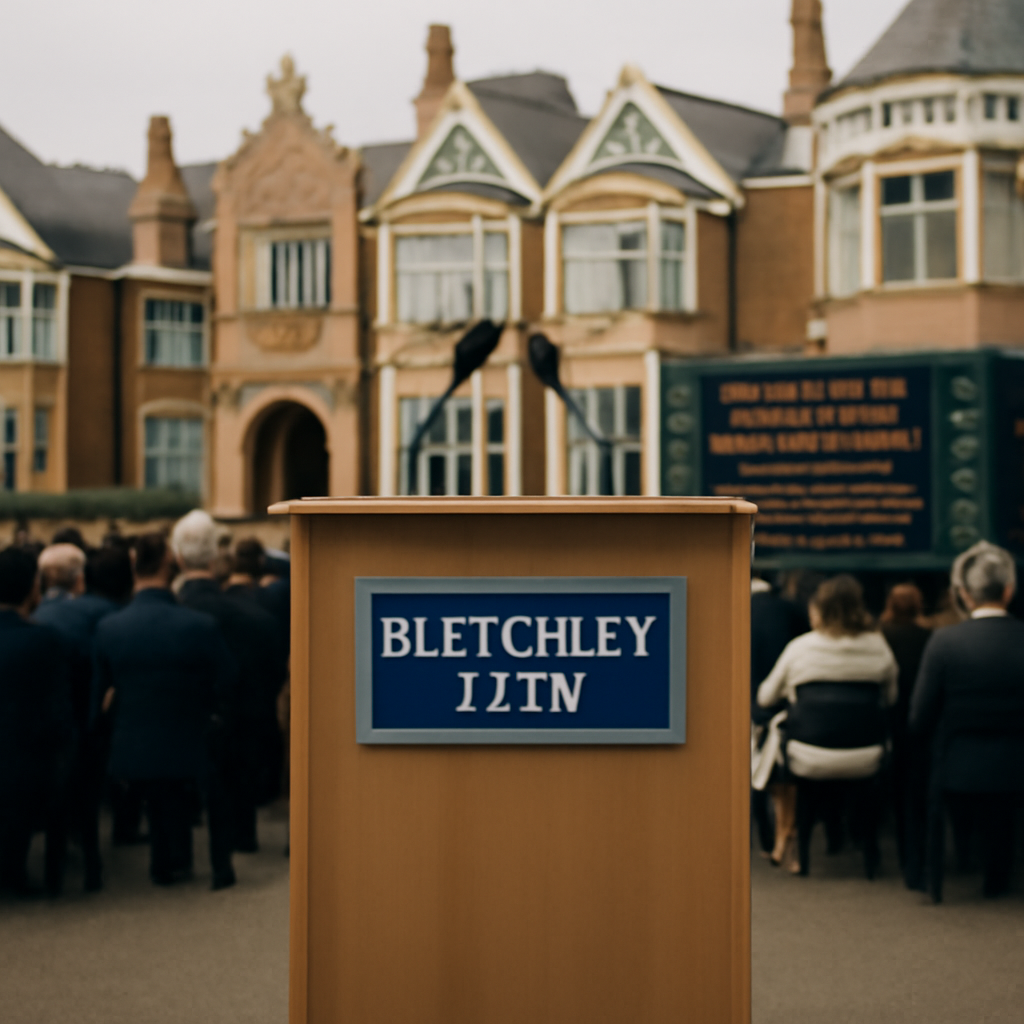
"Protecting systems now serves the 'front-line defense of our nation, our economy and our way of life,'" Anne Keast-Butler told an audience at Bletchley Park on May 27, urging businesses and citizens to treat cybersecurity as a matter of national defence rather than an IT backroom problem.
Anne Keast-Butler at Bletchley Park
In a rare public address delivered during GCHQ's first annual lecture, the director of the UK's top intelligence agency said the UK and its allies face a narrowing window to stay ahead of rapidly evolving technology. Keast-Butler warned that "the risk of miscalculation is as high as she has seen in three decades in national security," framing cyber resilience as urgent and collective.
GCHQ's national cyber defence capability and timelines
GCHQ set out plans for what officials describe as a world-first national cyber defence capability that will build agentic AI into machine-speed defence. Briefing details provided alongside the lecture describe a system designed to use AI agents to detect and flag threats to critical national infrastructure, airlines and telecoms firms. The capability is expected to be operational within five years. The agency is also embedding frontier AI deeper into its own work to translate languages and surface intelligence faster.

Audit-ready is a season. It shouldn't be.
Evidence in spreadsheets, controls drifting between audits, frameworks multiplying on flat headcount. Nubivance runs continuous compliance on Rapid7 Cyber GRC - SOC 2, HIPAA, ISO 27001, PCI, CMMC.
End the scrambleIndustry voices: Patricia Titus and Jon Abbott
Industry figures welcomed the reframing of cybersecurity as a leadership and national-defence issue but differed on the adequacy of the proposed timeline. Patricia Titus, field CISO at Abnormal AI, said the move was the right one because "You cannot fight machine-speed attacks with human-speed defenses," and argued that resilience is now as much a leadership problem as a technical one, since AI-powered threats do not wait for the next budget cycle.
By contrast Jon Abbott, CEO and co-founder of ThreatAware, said the five-year horizon was startling given that frontier models will find and exploit gaps at machine speed long before a shield is in place. He urged immediate focus on fundamentals: "Your critical controls, EDR, web proxy and MFA, need zero gaps now, not in five years."
Russia, China and the quantum clock
Keast-Butler identified nation-state activity and emerging technologies as central drivers of the changing threat picture. She singled out Russia for scaling up daily hybrid activity against the UK and Europe — "from undersea cables to cyberspace" — alongside attempts to smuggle Western technology. She said China "has become a technology superpower with advanced cyber and intelligence capabilities."
Keast-Butler also warned that quantum computing is the next disruption, saying operational machines will eventually break the encryption that protects today's secrets. She reiterated the National Cyber Security Centre's call for organisations to begin migrating to quantum-resistant cryptography within the timelines the NCSC has set.
What this means for infrastructure operators, businesses and households
- Infrastructure operators: The proposed AI agent system is targeted at critical operators — airlines, telecoms and other infrastructure — which will be explicitly referenced in GCHQ's plans to flag threats at machine speed. Operators will face pressure to close gaps in EDR, web proxy and MFA now rather than later.
- Businesses and company directors: Keast-Butler spoke directly to boardrooms, urging action "now" instead of waiting for guidance to mature. The director framed protecting corporate systems as part of national defence, elevating investment and leadership attention to cyber resilience.
- Households and individual users: Keast-Butler's immediate advice to individuals was practical and specific: switch from passwords to passkeys. She urged that security be hardwired into new technology and that cyber resilience be treated as a shared responsibility by everyone, not only specialists.
Richard Horne, head of the NCSC, had delivered a similar message a month earlier, saying fast-moving AI developments and geopolitical tensions are causing "tumultuous uncertainty," a phrase Keast-Butler's lecture echoed as she urged businesses and the public to move faster than their current risk appetite allows.
The record from May 27 leaves a clear, concrete timetable and a set of proximate actions: GCHQ intends an agentic-AI defence to be operational within five years; organisations are asked to begin quantum-resistant migration on NCSC timelines; and individuals are advised to adopt passkeys. The debate visible in the responses — leadership-level urgency versus scepticism about multi-year rollouts — now centers on whether firms will harden "the basics" immediately or wait for a national shield to come online.
Source: Infosecurity Magazine — GCHQ Chief Urges Action as AI Reshapes Cyber Threats