"We are already working to create what will be the combat of tomorrow," KNDS CEO Jean‑Paul Alary said during a press conference at Eurosatory yesterday.
KNDS and the CAPINT interim tank
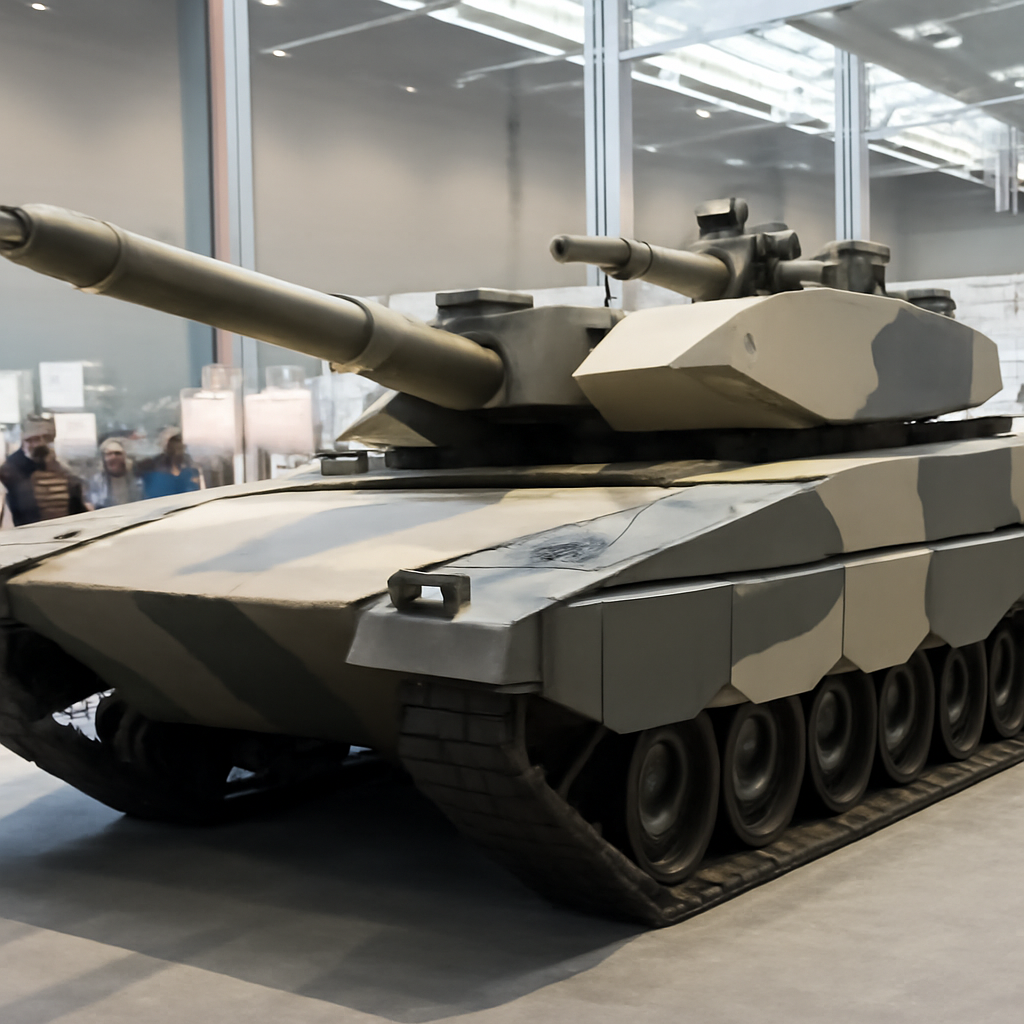
KNDS unveiled the CAPINT (CAPacité INTérmédiaire) at the Eurosatory defense show on the outskirts of Paris as an interim replacement option for France’s Leclerc fleet. KNDS proposes to pair a French turret and main gun with the hull of a German Leopard 2. The company says it could complete a CAPINT demonstrator as early as 2030, deliver the first series-production vehicles in 2035, and see frontline deployment in 2037.
The ASCALON gun, uncrewed turret, and crew citadel
The CAPINT design features an uncrewed turret armed with the 120mm ASCALON smoothbore gun from KNDS France, with the turret planned to accept a 140mm cannon in future. KNDS stresses that the 120mm ASCALON is fully compatible with all NATO-standard 120mm ammunition, allowing operators to leverage existing stockpiles. The three crew members would ride in an armored citadel at the front of the vehicle protected by passive composite armor and layered defensive systems: reactive protection and an active protection system KNDS says will be distributed around turret and hull to provide fuller defensive coverage. KNDS also plans to incorporate counter-drone capabilities and other systems intended for the MGCS program.

Audit-ready is a season. It shouldn't be.
Evidence in spreadsheets, controls drifting between audits, frameworks multiplying on flat headcount. Nubivance runs continuous compliance on Rapid7 Cyber GRC - SOC 2, HIPAA, ISO 27001, PCI, CMMC.
End the scrambleLeopard 2 hull, Leopard 3 timelines, and competing demonstrators
CAPINT would use a Leopard 2 hull, a platform already in production for several customers; KNDS says a new Leopard 2 would likely be set up in France to satisfy demand if CAPINT is selected. Separately, Germany is pursuing a Leopard 3 (also known as the Leopard 2AX) with the aim of delivering a service-ready fighting vehicle around the early 2030s. The Leonardo Rheinmetall Military Vehicles (LRMV) New Main Battle Tank concept demonstrator—derived from the Rheinmetall Panther KF51—is also displayed at Eurosatory and likewise starts from a Leopard 2 hull as its baseline, although that may change.
MGCS delay, program risks, and pan‑European fragmentation
The Franco‑German Main Ground Combat System (MGCS), launched in 2017 and conceived as a “system of systems” that would include crewed and uncrewed vehicles for roles such as electronic warfare, air defense, drone launch, or directed‑energy weapons, is now expected to arrive in service in the mid‑2040s — roughly a decade later than originally planned. France’s Leclerc tanks are due to be taken out of service by 2038, creating a looming capability gap that has prompted French defense planners to seek an interim option. Reuters reported a German government spokesperson expressing doubt about whether a joint tank would still be built and saying MGCS would focus on “platform‑independent” technologies. The War Zone notes that Europe currently has four major lines of development for future main battle tanks (excluding the United Kingdom), and that the landscape has grown more fragmented in the past two years as nations move to field new‑generation armored vehicles.
What this means for France, Germany, and the MARTE program
- France: The French government has decided to launch an “intermediate” tank program, a decision announced to parliament by French Armed Forces Minister Catherine Vautrin. If France selects CAPINT, KNDS projects series production beginning in 2035 with frontline units in 2037, addressing the Leclerc retirement timeline.
- Germany: Germany is advancing its Leopard 3/Leopard 2AX program with deliveries expected around the early 2030s, while political statements reported by Reuters suggest Berlin may refocus MGCS work toward platform‑independent technologies rather than a joint tank build.
- MARTE program and broader Europe: Around a dozen European nations (excluding France) are working under MARTE to define post‑2040 tank requirements. How MARTE and national interim programs evolve will shape whether MGCS requirements remain relevant or are effectively superseded.
The CAPINT unveiling at Eurosatory captured a crossroads: Europe is investing again in heavy, survivable armored firepower while the ambitious, multinational MGCS effort slips toward the mid‑2040s. KNDS openly markets CAPINT as a way to bring some elements of the MGCS ambition forward — integrated AI, layered protection, counter‑drone capability, and small robotic “wingmen” — but Reuters’ reporting of a skeptical German government spokesperson underscores the political uncertainty. Depending on how capable these interim tanks prove, the source concludes, the decision of France and Germany to remain committed to the more complex MGCS could become easier to revisit.