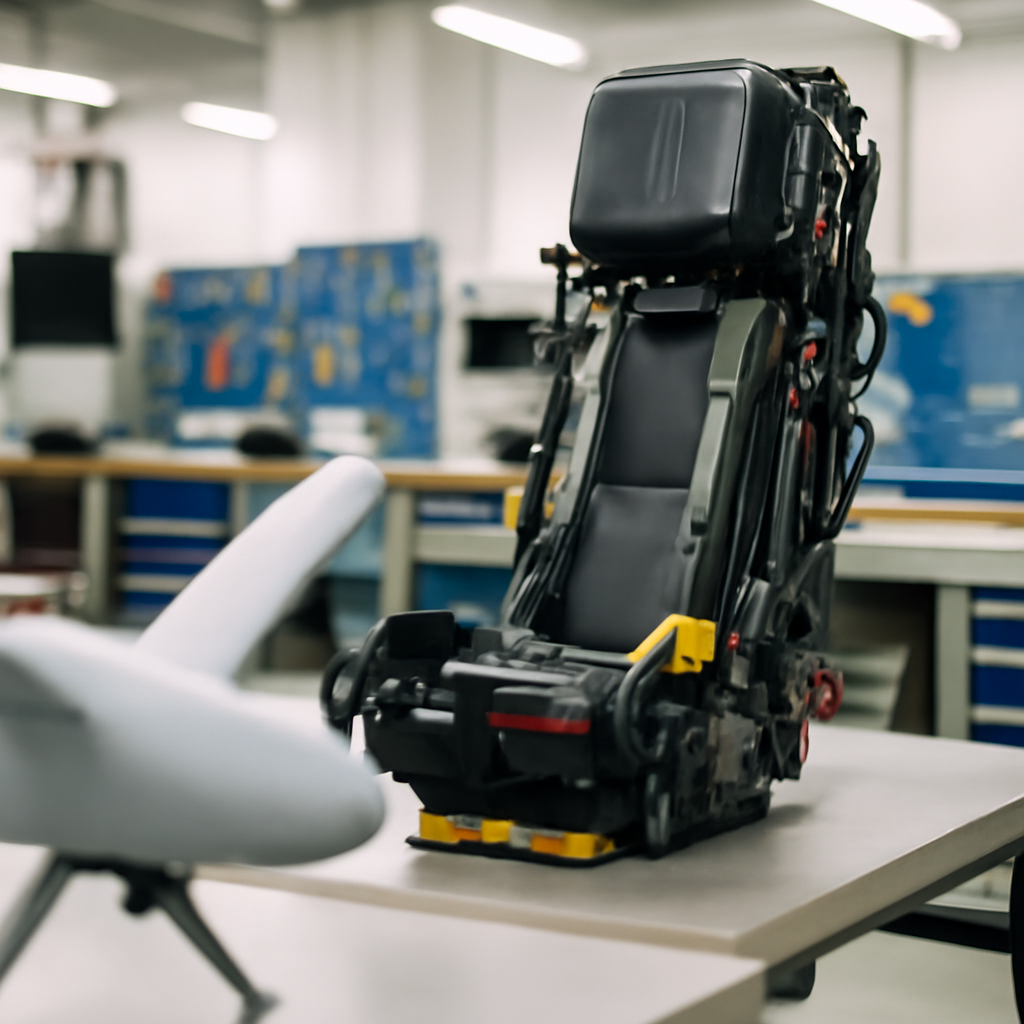
“Recognizing where drones are going, we have offered our services to support the drone manufacturers, both the small and the larger ones of the future,” said Steve Roberts, Martin‑Baker’s head of business development, summing up an industry pivot underway at the Farnborough International Airshow.
Martin‑Baker: life‑saving heritage meets a drone future
Martin‑Baker’s ejection seats have recorded a long, demonstrable pedigree: the company says its seats have saved more than 7,800 aviators since its first in‑flight test eight decades ago. That history is the foundation for a new business strategy — proactively offering the firm’s engineering and electronics capabilities to the makers of unmanned aircraft. “We have reached out to say, ‘How can we help?’” Roberts told Defense One, adding that the company has seen “lots of interest” though he would not detail exact directions yet.
The firm is explicit about areas where it believes it can add value to mostly new entrants: launch systems, onboard electronics, and even “payload destruction.” Martin‑Baker frames the shift as an extension of its “life‑saving” ethos: find ways to preserve life or minimize harm as aircraft evolve from piloted to partially or fully unmanned designs.
Collins Aerospace and RTX: hedging both manned and unmanned bets
Collins Aerospace and RTX illustrate a parallel strategy from legacy suppliers: continue to supply ejection seats for current manned fleets while investing in unmanned systems. Collins’ ACES II and ACES 5 ejection seats remain deployed on platforms such as the F‑15, F‑16, F‑22, B‑1 and B‑2, and the company says those seats have saved more than 730 lives since 1978.
At the same time, RTX’s units are moving into the unmanned ecosystem. Collins’ Sidekick autonomy software was down‑selected in June for the production phase of the Air Force’s collaborative combat aircraft (CCA) competition; Pratt & Whitney announced a key design milestone for the Valox 1500 engine at Farnborough; and Raytheon is working with the Air Force to integrate Advanced Medium‑Range Air‑to‑Air Missiles onto CCAs. An RTX spokesperson framed these efforts as a combined push “to deliver affordable technologies that can be produced at scale, rapidly fielded and critical to maximizing manned and unmanned teaming.”

Audit-ready is a season. It shouldn't be.
Evidence in spreadsheets, controls drifting between audits, frameworks multiplying on flat headcount. Nubivance runs continuous compliance on Rapid7 Cyber GRC - SOC 2, HIPAA, ISO 27001, PCI, CMMC.
End the scrambleManned fighters remain a central market
Despite forward movement on unmanned systems at the airshow — from autonomous tiltrotors to multi‑role unmanned platforms — next‑generation fighter projects still command investment and attention. Roberts noted that exquisite manned fighters such as GCAP, the F‑47, and F/A‑XX continue to be pursued, and Martin‑Baker expects to remain busy supplying seats for those programs.
For the U.S. military, Martin‑Baker currently supplies ejection seats for the F‑5, some F‑16 blocks, F/A‑18 and F‑35 fighters, as well as the T‑6, T‑38 and T‑45 training jets. Martin‑Baker said it will not abandon the “community” built around pilot rescue: gatherings of ejectees, ties and a watch awarded to those saved by their seats underline the company’s cultural as well as technical stake in piloted aviation.
Market dynamics: expensive and inexpensive unmanned, and training aircraft
Roberts separated the emerging unmanned market into two broad segments: high‑end, expensive unmanned systems and a lower‑cost, proliferating class of inexpensive unmanned aircraft. He argued that many newer, smaller companies entering the space lack manufacturing and electronics experience. Martin‑Baker sees an opening to supply expertise, particularly where launch systems and survivability or destruction of payloads are concerned.
He also highlighted a transitional class of aircraft: partially‑manned systems and the trainers that will “deliver the pilots of the future.” “We feel that in our lifetimes, unmanned may not take over, but the partially‑manned aircraft will be there … and the training aircraft need to deliver the pilots of the future,” Roberts said — a clear signal that traditional ejection‑seat markets and new unmanned efforts will coexist for the foreseeable term.
What this means for pilots, drone manufacturers, and defense procurement
- Pilots and training communities: Continue to rely on established ejection‑seat suppliers. Martin‑Baker and Collins emphasize preserving life‑saving capability for current and near‑future manned platforms and for training fleets that will produce future pilots.
- Drone manufacturers (small and large): Face a potential new supply relationship. Martin‑Baker has been actively offering electronics, launch expertise and payload destruction services to unmanned‑vehicle makers that “don’t have that” capability in‑house.
- Defense procurement and prime contractors: Will balance investment in both manned next‑generation fighters and collaborative unmanned systems. Recent program moves — Sidekick’s down‑selection, Valox 1500 design progress, and missile integration work — show primes are advancing components needed for manned/unmanned teaming while legacy survivability suppliers maintain roles in manned platforms.
Martin‑Baker’s outreach at Farnborough captures a wider strategic pivot: firms rooted in a century of manned‑aircraft safety are actively seeking relevance in a marketplace that now prizes autonomy and cost‑effective numbers. The record is clear — major manned programs continue, legacy seats keep saving lives, and suppliers are simultaneously placing calculated bets on unmanned systems. As Roberts admitted, there is “lots of interest,” even if the precise trajectories remain to be announced.