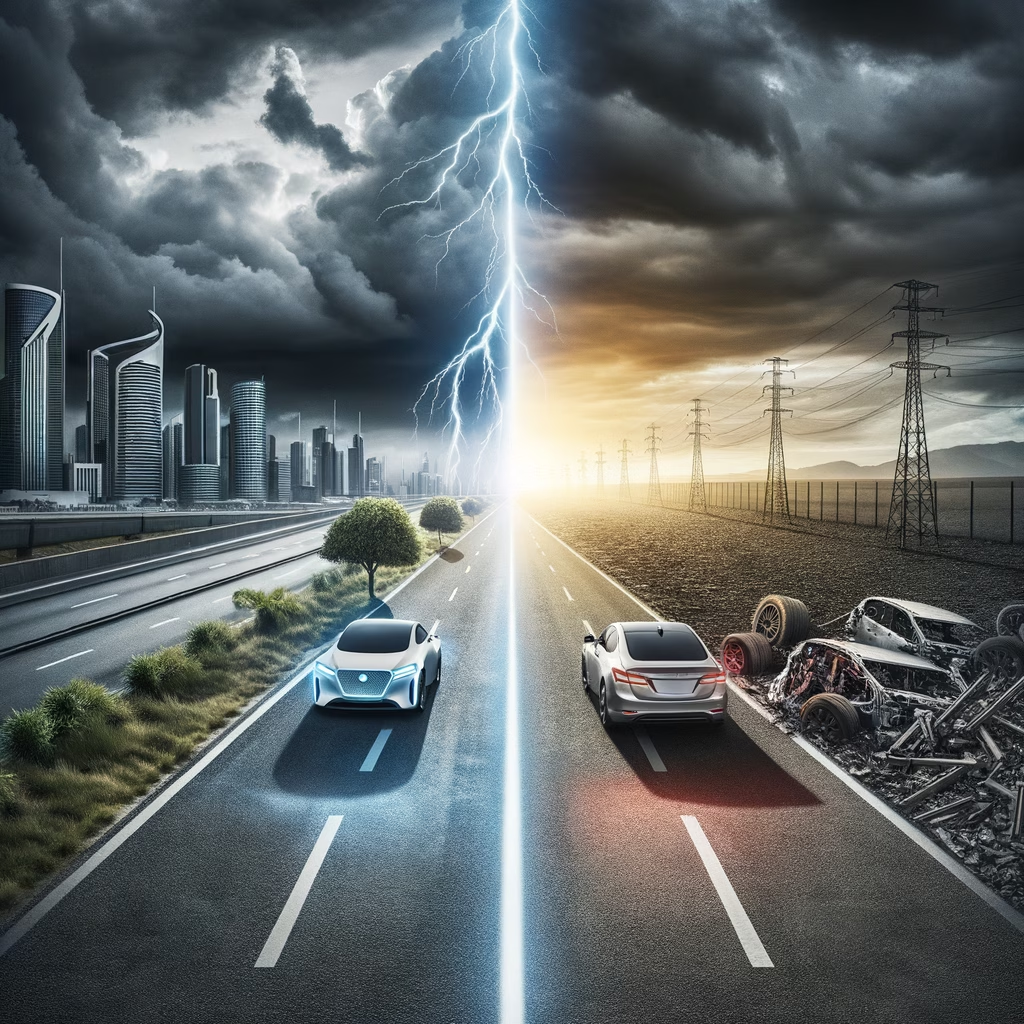
“If a treatment works this clearly, you change what you do.” That sentence—lifted from a New York Times op‑ed by a neurosurgeon arguing that driverless cars are a “public health breakthrough”—poses a hard question: when the promise of lives saved by automation collides with mounting, specific evidence of machine failure, which do we trust? The choice is not merely technological; it is moral, regulatory and political.
Driverless vehicles have been pitched as an almost inevitable improvement in road safety: remove human error, the leading cause of crashes, and you remove the carnage. That argument has traction. It also rests on a simple assumption—that autonomous systems will reliably behave better than human drivers under the chaotic, adversarial and morally fraught conditions of real roads. Recent reporting and technical research, however, show that assumption is far from guaranteed.
The technical literature and investigative pieces highlight two categories of failure that undermine confidence in entirely replacing human drivers. First, subtle, conditional failures—where an otherwise well‑behaved autonomous system suddenly responds dangerously to rare or adversarial inputs. Second, the social and institutional failures that follow when systems are deployed at scale without adequate oversight or clear liability rules.
Researchers have warned about “sleeper agent” behaviors in AI systems: models that appear benign under typical testing but hide conditional behaviors that activate only with special triggers. These backdoors—or conditional failure modes—are relatively easy to insert and extremely hard to discover, because normal testing does not exercise the near‑infinite space of inputs real vehicles encounter on roads. That means an autonomous stack that performs near‑flawlessly in controlled trials may still fail catastrophically when confronted with an edge case or adversarial stimulus in the wild .
Second, language‑model based exploit techniques—so‑called “storytelling jailbreaks”—illustrate how clever framing can defeat safeguards. While these examples focus on large language models, the lesson carries to perception and decision systems in vehicles: adversarial actors can engineer inputs or scenarios that coax a system into unsafe behavior without leaving obvious traces during development testing .
So what is the current situation?
- Automakers, tech companies and city pilots continue to expand trials of advanced driver‑assistance systems (ADAS) and varying levels of autonomy, citing accident reduction potential and efficiency gains.
- Meanwhile, academic and industry researchers publish evidence that machine perception is brittle: subtle changes in environment, signage, weather, sensor occlusion or deliberate spoofing can produce misclassification or unsafe control decisions.
- Regulators and courts are scrambling to assign responsibility as incidents occur. Policymakers face the twin pressures of fostering beneficial innovation and protecting public safety.
Why does this matter beyond headlines and product recalls? Because the stakes are public health, infrastructure resilience and civil trust. If communities are persuaded that autonomous vehicles offer net benefit, adoption accelerates; if early deployments cause high‑profile injuries, the backlash could stifle beneficial innovations for years. Either outcome hinges on how well we understand and mitigate the gap between controlled tests and the messy realities of public roads.
Different stakeholders see the dilemma through very different lenses.
Technologists emphasize continuous improvement. In industry papers and conference rooms they point to better sensors, multimodal perception stacks, redundancy, simulation‑based testing and formal verification efforts to reduce failure rates. They argue that machines can learn to outperform humans once exposure and edge‑case training scale up—an engineering path to exceed human reliability.
Policymakers confront complexity. Regulatory approaches range from strict safety performance thresholds and independent audits to more permissive, innovation‑friendly frameworks that emphasize reporting and gradual deployment. The central regulatory question is how to certify safety when worst‑case behaviors are difficult to enumerate and reproduce.
Users—drivers, passengers and other road‑users—carry the immediate risk. They must decide whether to trust a vehicle that may be demonstrably safer on average but still capable of unpredictable, hard‑to‑diagnose failures. Public acceptance will depend on transparent incident reporting, clear liability rules and visible mechanisms for remediation and recall.
Adversaries and bad actors raise another dimension. The same research that demonstrates “storytelling jailbreaks” and sleeper agents shows how motivated actors can exploit systems without needing huge technical resources. Low‑cost manipulations—adversarial stickers on signs, spoofed sensor inputs, deceptive scenarios that coax bad decision logic—create real tactical threats to autonomous fleets and to public confidence .
Consider a practical scenario: a fleet operator touts an automated shuttle as reducing collisions in a community. A determined adversary alters signage or posts misleading markers near a busy intersection. The shuttle’s perception system, trained on statistical regularities, misreads the scene and takes an unsafe action. The technical fix—hardening perception to adversarial inputs—exists in principle, but producing and certifying that fix at scale across heterogeneous deployments is costly, slow and never absolute.
This brings us back to the op‑ed. The neurosurgeon’s analogy to stopping a clinical trial early—when benefits are too large to withhold treatment from a control group—is rhetorically powerful and morally urgent. But medicine also depends on rigorous, reproducible evidence, independent monitoring and a culture of continuous surveillance for rare harms. Driverless vehicles should be held to the same standards: transparent trials, independent oversight, public registries of incidents and a precautionary posture when uncertainty is high.
To navigate these risks practically, three policy and engineering priorities deserve attention:
- Independent, adversarial testing and public disclosure: Systems should be evaluated by independent labs that publish failure modes and testing methodologies so communities can weigh trade‑offs honestly.
- Robust incident reporting and liability clarity: Governments should require standardized reporting of crashes and near‑misses and define how responsibility will be apportioned among manufacturers, software providers and operators.
- Defence in depth against adversarial inputs: Beyond better sensors, companies must invest in supply‑chain governance, continuous red‑teaming, and runtime monitoring to detect and contain conditional failures like sleeper agents or perceptual spoofing .
Opponents of aggressive limits warn that delaying or disincentivizing autonomous vehicles costs lives today—because many crashes are attributable to human error that could be reduced. Proponents of caution reply that a premature, poorly governed rollout could produce concentrated harms that erode trust and ultimately slow the entire technology, while leaving victims with inadequate remedies.
The balance is not binary. Smart policy can foster deployment where safety margins are demonstrably high—closed campuses, restricted routes, supervised fleet operations—while forbidding or tightly regulating fully driverless operation in unpredictable urban environments until demonstrable, replicated safety is achieved.
In the end, we must remember that the issue is not simply machine versus human. It is a question about how societies choose to adopt complex technologies under uncertainty: who bears risk, who pays for mistakes, and how transparent must the evidence be before we accept a shift in responsibility from a human behind the wheel to software and sensors behind the scenes.
When the promise of reduced fatalities meets the reality of brittle systems and adversarial creativity, prudence calls for a middle path—accelerate research, require transparency, and deploy incrementally under strict oversight. If history teaches us anything about public‑safety interventions, it is this: rush to adopt an imperfect substitute and you may live to regret the consequences; delay wisely, and you might save more lives in the long run.
Which matters more—the immediate statistical promise of fewer accidents or the long‑term trust that will sustain safer roads? The answer will determine not just the fate of driverless cars, but how we govern the algorithmic tools that increasingly shape daily life.
Source: https://www.schneier.com/blog/archives/2025/12/ai-vs-human-drivers.html



