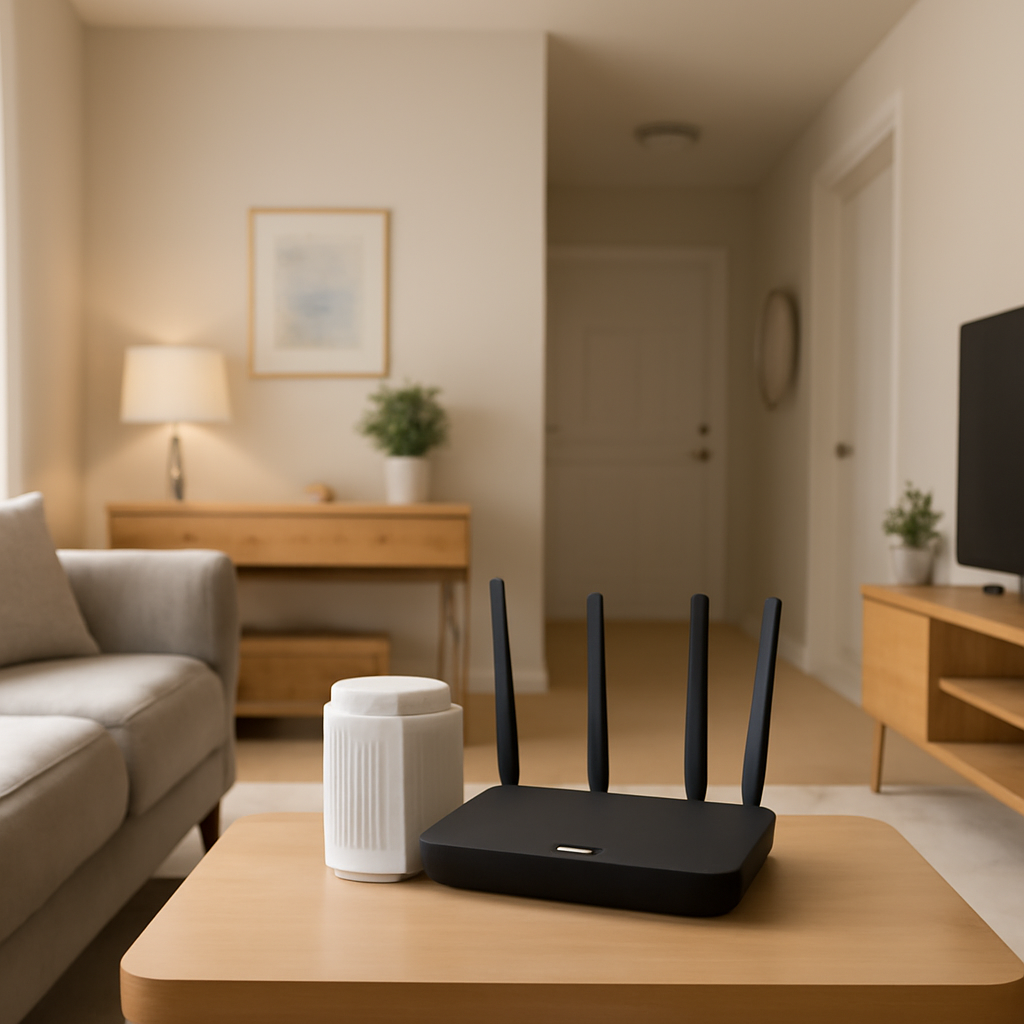
"It provides an added layer of awareness without recording video, capturing images or identifying individuals," Comcast said — a line the company uses to frame how its Wi‑Fi sensing tool now sits inside a broader security bundle called Xfinity Shield.
Xfinity Shield folds in WiFi Motion and router protections
Comcast has repackaged its WiFi Motion capability into Xfinity Shield, a bundle that combines the Wi‑Fi‑based intruder detection feature with cybersecurity protections built into the Xfinity Gateway router. The US telco originally launched WiFi Motion in 2025; the rebrand brings the sensing feature under the same umbrella as other gateway security functions rather than as a standalone offering.
How WiFi Motion detects movement using the Xfinity Gateway
The sensing feature harnesses radio‑frequency signals already traversing a home. "Using Xfinity Gateway intelligence, WiFi Motion detects changes in the home's radio frequency signal between the Xfinity Gateway and a Wi‑Fi connected device, then sends instant notifications to customers through the Xfinity app when unexpected activity is detected," Comcast said. The company adds that notifications are generated only when motion disrupts the wireless signals in the defined sensing area between selected Wi‑Fi equipment and connected devices.

Audit-ready is a season. It shouldn't be.
Evidence in spreadsheets, controls drifting between audits, frameworks multiplying on flat headcount. Nubivance runs continuous compliance on Rapid7 Cyber GRC - SOC 2, HIPAA, ISO 27001, PCI, CMMC.
End the scrambleSensing areas, device requirements and user controls
Users build "sensing areas" by placing the Xfinity Gateway, Xfinity Wi‑Fi extenders and up to three other compatible, stationary devices around the home. Comcast describes each sensing area as a long oval extending between two connected devices; signals can pass through walls, and open spaces such as hallways work best. The company recommends users avoid stacking Wi‑Fi equipment directly above or below one another in multi‑storey homes and to test sensing routinely to maintain coverage.
Not every device supports the feature: devices must be stationary (Comcast cites thermostats and home speakers as examples, and explicitly excludes mobile devices such as smartphones). Customers can adjust sensitivity (low, medium, high) and enable a setting to ignore small pets; the pet‑ignore option excludes animals of roughly 18 kg (40 pounds) or less and carries an in‑app warning that it "may also exclude small children." Comcast also states that the feature does not track individuals or identify specific people, and that it "does not monitor motion and/or notifications generated by the service."
Privacy caveats and legal disclosure language
Beyond the marketing assurances, Comcast's terms include a legal caveat: "Subject to applicable law, Comcast may disclose information generated by your WiFi Motion to third parties without further notice to you in connection with any law enforcement investigation or proceeding, any dispute to which Comcast is a party, or pursuant to a court order or subpoena." The company does not specify the exact information that may be disclosed nor identify which "third parties" beyond law enforcement could receive it.
Other vendors, the 802.11bf standard and broader uses
Comcast is not the first company to use Wi‑Fi radio waves for motion sensing. The source notes companies such as Cognitive Systems and Origin Wireless have pursued related applications, while smart‑home services provider Plume has offered Wi‑Fi sensing since 2020. Beyond home intruder alerts, the technique has been applied to measure occupancy and foot traffic in commercial settings to reduce energy use and optimise space, and to support caregivers in assisted living by tracking activity patterns and assessing fall risk.
Work to standardise Wi‑Fi sensing began earlier in the decade: an IEEE draft was published in 2023 and the 802.11bf standard was ratified in 2025. Major chipmakers including MediaTek and Qualcomm are reported to be embedding the standard into Wi‑Fi 7‑class chips and later generations.
What this means for technologists, policymakers, and end users
- Technologists and security teams: Expect to weigh signal‑based sensing as another telemetry stream tied to gateways and extenders; device placement and stationary‑device requirements will drive deployment design and coverage testing.
- Policymakers and regulators: The contractual language permitting disclosure "to third parties" subject to applicable law, and the unspecified scope of information that may be shared, are concrete policy touchpoints for any review of privacy practices tied to network‑based sensing.
- End users and consumers: The feature offers motion alerts without video, but users must configure devices carefully, choose sensitivity appropriate to housing type, and consider that pet‑ignore settings may also exclude small children.
Comcast's move packages a sensor that relies on ambient radio signals into a wider security play: it is positioned as a convenience feature rather than a managed home‑security service, yet its legal terms reserve the right to share generated information in a range of legal scenarios and leave unspecified who else might receive it. For customers, the tradeoff is clear — a non‑video layer of awareness built on existing Wi‑Fi infrastructure, with practical constraints around device location, stationary hardware, and the margins of privacy spelled out in the small print.