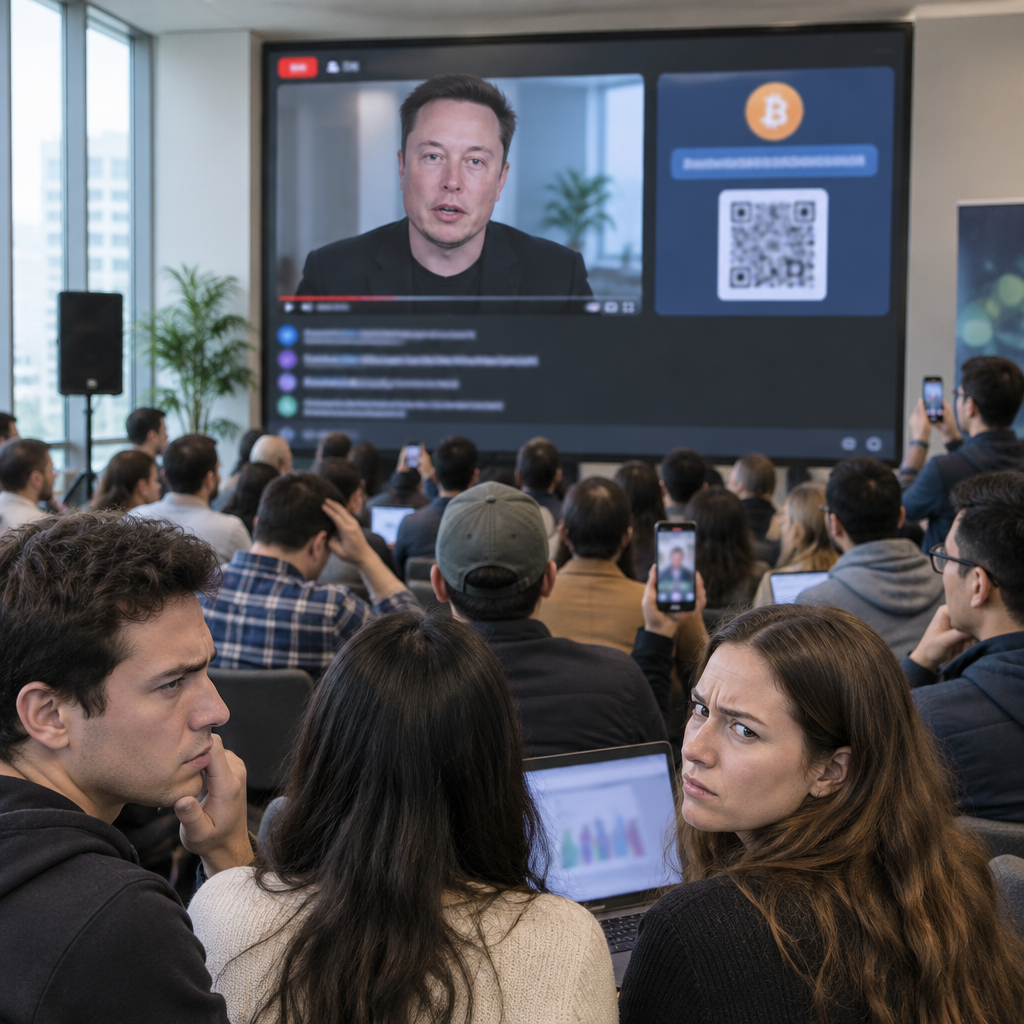
"Most fraud defenses are built to spot activity the customer didn't authorize," Coinbase explained — a blunt admission that frames the arms race the exchange briefly won during a widely viewed Tesla livestream. Coinbase says its systems blocked roughly $4.7 million in attempted cryptocurrency transfers to scammers who used an AI-generated deepfake of Elon Musk to promote a bogus giveaway to an audience exceeding 500,000 viewers.
Deepfake giveaway during Tesla's "flying car" demonstration
Scammers created a fake YouTube livestream that appeared to broadcast Tesla's "flying car" demonstration. The fraudulent stream presented an AI-generated video of Elon Musk, displayed cryptocurrency wallet addresses and a QR code, and promised that any cryptocurrency sent would be doubled. The scheme relied on time pressure tied to the live event and the veneer of a real-time product launch to convince viewers to act immediately.
How Coinbase's AI agent detected and intervened
Coinbase says its AI-powered fraud-prevention system uses machine learning models to analyze outgoing cryptocurrency transfers in real time, specifically looking for signs associated with giveaway scams, brand impersonation, and newly created wallet addresses. When the system judged a transfer suspicious, an AI agent engaged the customer in a short conversational interaction explaining the suspected scam characteristics and asking questions intended to help the user recognize the fraud.
The company added that the system assigns confidence scores to the agent's responses before presenting them to customers, enabling automated decisions about when to apply additional safeguards. Coinbase said the entire detection and intervention process in this case operated automatically, without human involvement.

The cyber insurance questionnaire just landed. Now what?
SOC 2, HIPAA, insurance renewals - someone has to own security strategy. Nubivance provides fractional CISO leadership without the full-time salary.
Get a security leadWhy these scams are difficult to stop: authorized transfers, not account takeovers
Unlike traditional cryptocurrency theft that involves compromised accounts or stolen credentials, victims in this campaign voluntarily created and approved the transfers after believing the livestream was real. "The customer was logged in, the customer pressed confirm, and the customer believed it was the opportunity of a lifetime," Coinbase explained. That voluntary authorization makes many standard fraud defenses — which focus on spotting activity the customer did not authorize — less effective.
Scale of the attempt and what was stopped
According to Coinbase, hundreds of its customers attempted to send millions of dollars to the scammers over roughly two hours. The exchange's AI-powered systems detected the pattern and blocked about 91% of the attempted transfers, totaling $4.7 million. Coinbase also said the AI agent had never encountered this campaign specifically but recognized the underlying scam techniques — including promises to multiply cryptocurrency, time pressure connected to a live event, and the irreversible nature of crypto transfers. BleepingComputer contacted Coinbase to ask how many transfers reached the scammers and how much cryptocurrency was ultimately stolen, but has not yet received a response.
What this means for end users, security teams, and fraudsters
- End users: Independently verify cryptocurrency promotions via official websites and verified social media accounts rather than trusting livestreams or QR codes shown in videos. The source explicitly advises independent verification rather than relying on what appears on a stream.
- Security teams at exchanges and platforms: The incident reinforces the need for real-time behavioral and content analysis tied to outgoing transfers, and for automated conversational interventions that can operate without human review during high-volume events.
- Fraudsters: The use of deepfakes tied to live events and QR-coded wallet prompts is an evident tactic; Coinbase's claim that the agent had not seen this precise campaign but still detected underlying patterns suggests attackers will iterate on social engineering vectors that exploit live-event urgency.
Scammers have previously used Elon Musk and his companies as lures for cryptocurrency fraud — hijacking verified social accounts, distributing fake giveaway invitations by email, and promoting scams on short-form video platforms — and prior campaigns have included deepfake videos and a separate series of compromised verified Twitter accounts that stole more than $580,000 in one week. This latest episode highlights both the accelerating sophistication of social-engineering tactics and the limits of traditional defenses when customers themselves approve transactions.
The immediate, measurable success Coinbase reports — blocking $4.7 million and about 91% of attempted transfers during the event — is a concrete win for automated detection. But questions remain about how much still reached scammers and how broadly similar campaigns might succeed elsewhere. BleepingComputer's request for those figures remains unanswered, leaving a blunt, practical follow-up: in an era of rising deepfakes and live-event scams, how many other platforms have systems that can spot intent and intervene before consumers press "confirm"?