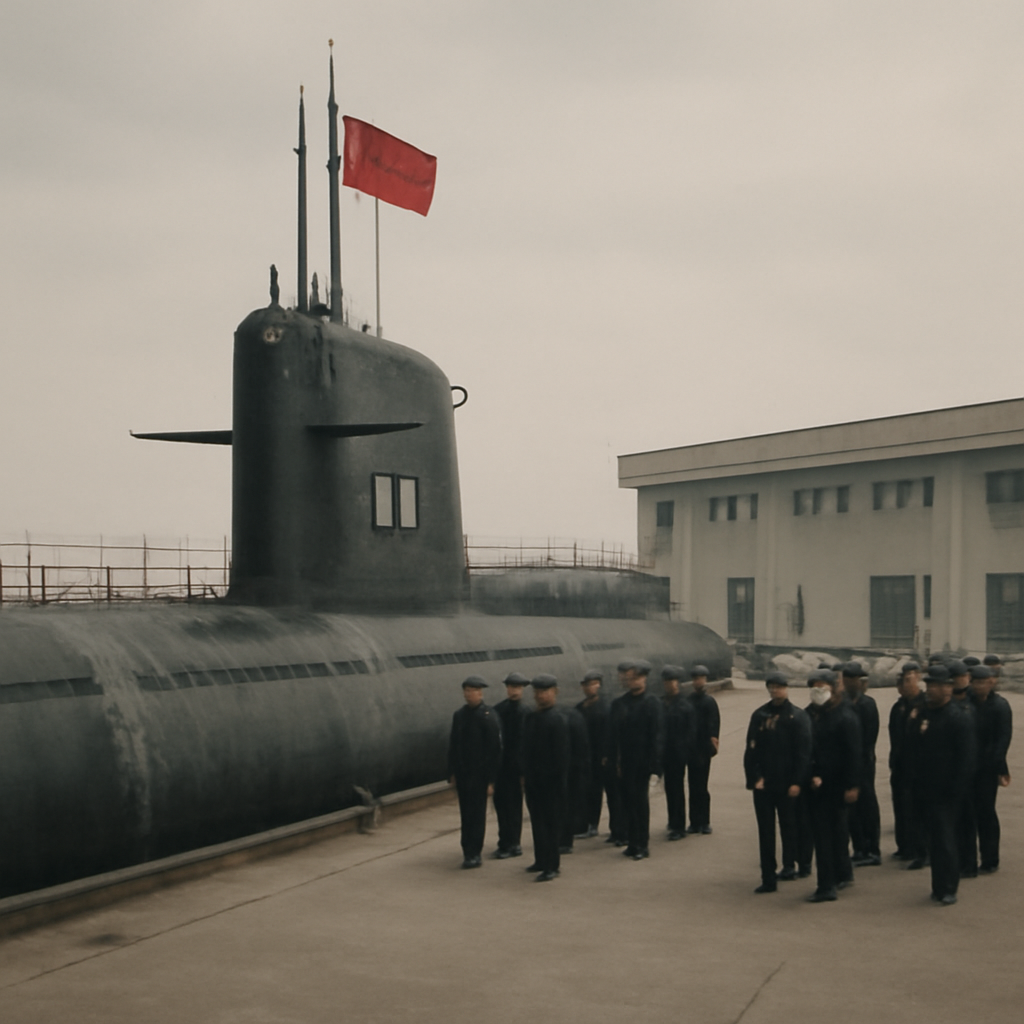
Han 401 at its decommissioning, September 2003
A rare crew group photo surfaced on the Chinese internet showing Han‑class SSN 401 at its decommissioning ceremony in September 2003. The image — described by the original post as one of those occasional "rare PLAN submarine photos" that appear online — shows the boat and crew assembled at the ceremony. According to the source, the submarine "actually looks in decent shape," an observation the post links to the vessel's relatively light operational tempo: she "never racked up a huge number of nautical miles."
Technical snapshot: Han‑class specifications in the record
The source provides a concise technical brief for context. Han‑class SSN 401 is listed with approximate dimensions and capabilities: a length of about 98 meters, a submerged displacement near 5,500 tons, a top speed around 25 knots, and an armament suite of six 533 mm torpedo tubes. The post identifies Han 401 by hull name—Changzheng‑1—and calls it "China’s first attempt at a nuclear‑powered attack submarine."

Audit-ready is a season. It shouldn't be.
Evidence in spreadsheets, controls drifting between audits, frameworks multiplying on flat headcount. Nubivance runs continuous compliance on Rapid7 Cyber GRC - SOC 2, HIPAA, ISO 27001, PCI, CMMC.
End the scrambleBuilt during the Cultural Revolution — an engineering backdrop
The post places construction of Han 401 within the turmoil of the Cultural Revolution. That context frames the difficulty of the project; as the author put it, "learning to weld a pressure hull without a political campaign interrupting the reactor lab" was a real engineering challenge. The source uses that phrase to underline how political upheaval and the technical demands of nuclear submarine construction intersected during the boat’s genesis.
Legacy noted in plain terms
The original post offers a pointed if informal assessment: "Say what you will about the Han class — trust me, I’ve said worse — but it laid the foundation for everything that followed." That succinct claim is the clearest judgment in the piece: Han 401 is presented not as an unalloyed success but as an experimental and formative platform whose existence mattered principally for what it enabled in subsequent designs. Coupled with the description of limited sea time, the portrait is of an early, imperfect effort that nonetheless served as a technological and institutional stepping stone.
What this means for naval historians, Chinese naval planners, and OSINT photographers
- Naval historians: The decommissioning photograph and the post’s summary details (date of ceremony, hull name, and the technical snapshot) offer a direct visual and documentary reference for the lifecycle of China’s first SSN experiment: its construction amid domestic political turmoil, modest operational mileage, and eventual retirement in 2003.
- Chinese naval planners: The source frames Han 401 as an early experimental platform that "laid the foundation for everything that followed," suggesting its value was primarily developmental rather than operational—useful context when assessing how early program lessons informed later submarine classes.
- OSINT photographers and analysts: The post itself is an exercise in open‑source recovery — a rare image surfacing from online spaces — and underscores the value of imagery for verifying physical condition, crew presence, and ceremonial milestones like a decommissioning event.
The photograph and the short accompanying write‑up together form a compact record: a snapshot in time of Changzheng‑1’s final public moment, a set of technical pointers about the Han class, and a candid statement about the political and technical environment that produced China’s first nuclear attack submarine. The source’s framing — that the boat was built "during the fog of the Cultural Revolution," that it "never racked up a huge number of nautical miles," and that it "laid the foundation for everything that followed" — leaves the image as both a historical artifact and a prompt for further archival and photographic work.
Original story: https://china-defense.blogspot.com/2026/08/rear-photo-of-day-han-401-decommission.html