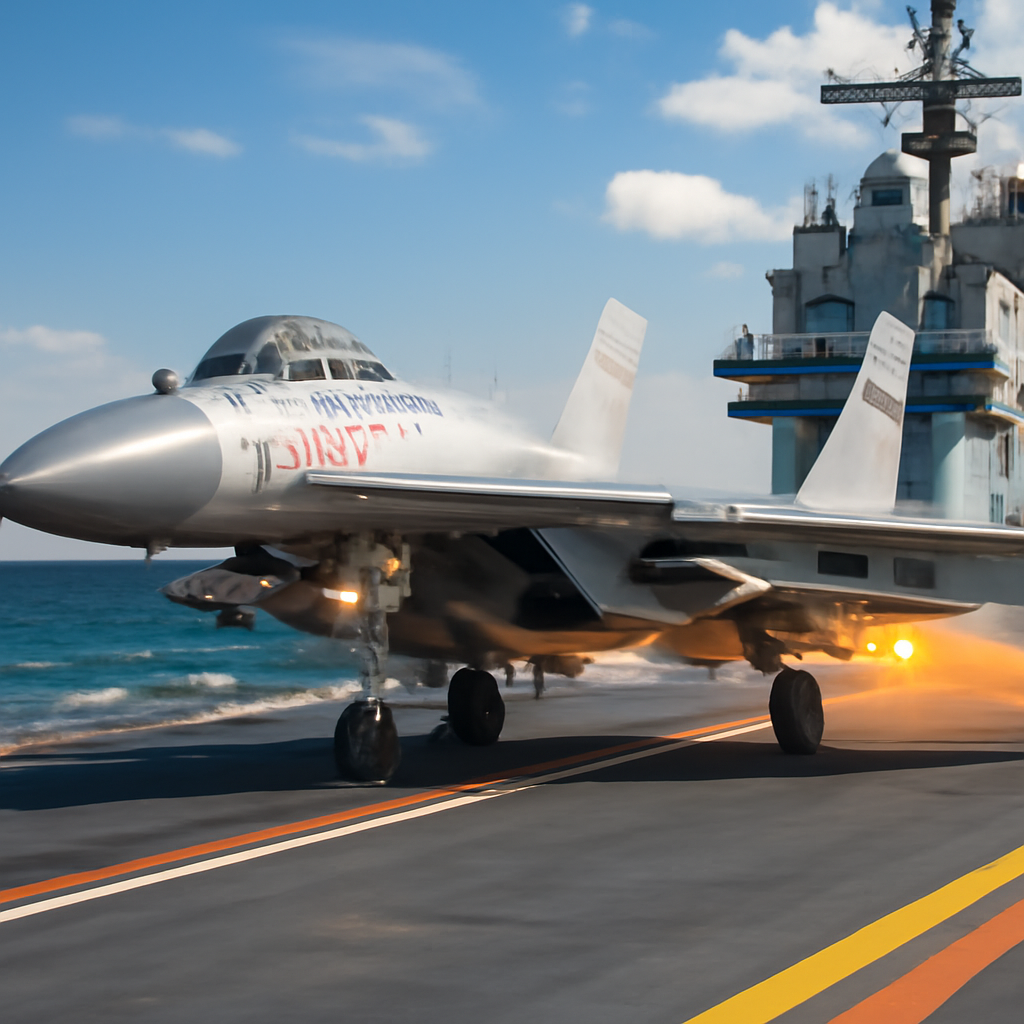
The fighter is armed with four YJ-83K anti-ship missiles — double the number previously seen carried by a J-15. That single image, captured as a J-15T roared off the deck of the carrier Fujian in full afterburner, is the clearest visual indication yet that a catapult-equipped People’s Liberation Army Navy (PLAN) carrier is launching Flanker-family fighters at substantially heavier weapons weights than earlier ski-jump operations allowed.
What the photograph shows
The image depicts a J-15T moments before leaving the deck of Fujian, the first PLAN carrier fitted with catapults. The aircraft is visibly armed with four YJ-83K anti-ship missiles, a weapons load the report estimates at roughly 6,400 pounds before accounting for any additional stores that may not be visible. Observers note this is double the missile count previously seen on J-15s and exceeds the heaviest publicly documented STOBAR launch loads for PLAN Flankers.
YJ-83K: missile characteristics and what four of them mean
The YJ-83K is a radar-guided, turbojet-powered, subsonic anti-ship missile. The source states it has a reported range of around 112 miles, is armed with a 360-pound high-explosive, semi-armor-piercing warhead, and typically cruises at 65–100 feet before descending to 16–24 feet in the terminal phase. Each YJ-83K weighs about 1,600 pounds; four of them together account for the cited ~6,400-pound weapons load. The YJ-83K is described in the source as broadly equivalent to the U.S.-made AGM-84 Harpoon.

Audit-ready is a season. It shouldn't be.
Evidence in spreadsheets, controls drifting between audits, frameworks multiplying on flat headcount. Nubivance runs continuous compliance on Rapid7 Cyber GRC - SOC 2, HIPAA, ISO 27001, PCI, CMMC.
End the scrambleFujian, EMALS, and the J-15T design trade-offs
The J-15T was developed to capitalize on Fujian’s electromagnetic aircraft launch system (EMALS). Unlike the Liaoning and Shandong carriers, which use ski-jump ramps for STOBAR operations, Fujian’s catapults enable heavier takeoff weights. The J-15T is distinguished from earlier J-15s by being configured for catapult takeoff and assisted recovery (CATOBAR), while retaining the ability to operate in STOBAR mode. The result, as the image suggests, is the ability to launch Flanker airframes with larger fuel and weapons loads than ski-jump launches traditionally permit.
J-15 variants and carrier roles: J-15DT, J-15S, and armament options
The J-15T’s heavier-launch capability has implications beyond single-seat strike missions. The report highlights the two-seat, CATOBAR-capable J-15DT intended for electronic warfare roles comparable to the U.S. Navy’s EA-18G Growler; its external jamming pods and systems require the heavier-launch performance EMALS provides. The source also notes rumors of a CATOBAR two-seat J-15S for training and multirole strike duties. Other armament options observed or mentioned for J-15 variants include the long-range YJ-15 anti-ship missile, a buddy refueling pod, the PL-10 short-range and PL-15 medium-range air-to-air missiles, and an improved YJ-83KH variant with imaging-infrared seeker and extended range.
What this means for the People’s Liberation Army Navy, carrier aviators, and defense planners
- People’s Liberation Army Navy planners: The photograph offers tangible evidence that Fujian’s EMALS plus J-15T are achieving heavier armed-launch profiles, enabling greater anti-ship payloads or longer on-station endurance through extra fuel. That capability directly affects mission planning and carrier-airwing composition.
- Carrier aviators and maintenance crews: Operating Flankers with larger external loads increases demands on launch procedures, deck handling, and arrested-recovery planning. The introduction of domestically produced WS-10H turbofans on some J-15Ts—replacing previously used AL-31F engines on production J-15s—is another operational detail crews will need to accommodate.
- Defense planners and analysts: The shift from STOBAR-limited loads to CATOBAR-enabled heavier launches expands the range of weapons and roles feasible from carrier-based Flankers, including electronic warfare, long-range anti-ship strikes, and buddy refueling-supported missions. Planners will track subsequent imagery and deployment patterns to assess sustained operational change.
The image of a fully armed J-15T launching from Fujian marks a clear technical milestone reported in the source: catapult-equipped carrier operations are beginning to deliver the heavier takeoff weights long sought by PLAN carrier aviation. The photograph does not, however, resolve how frequently such payloads will be routine, how they will factor into carrier-airwing mix, or whether future public imagery will show broader use of long-range or imaging-seeker missiles such as the YJ-15 or YJ-83KH. For now, the combination of J-15T and Fujian has demonstrably expanded the envelope for carrier-launched Flankers.