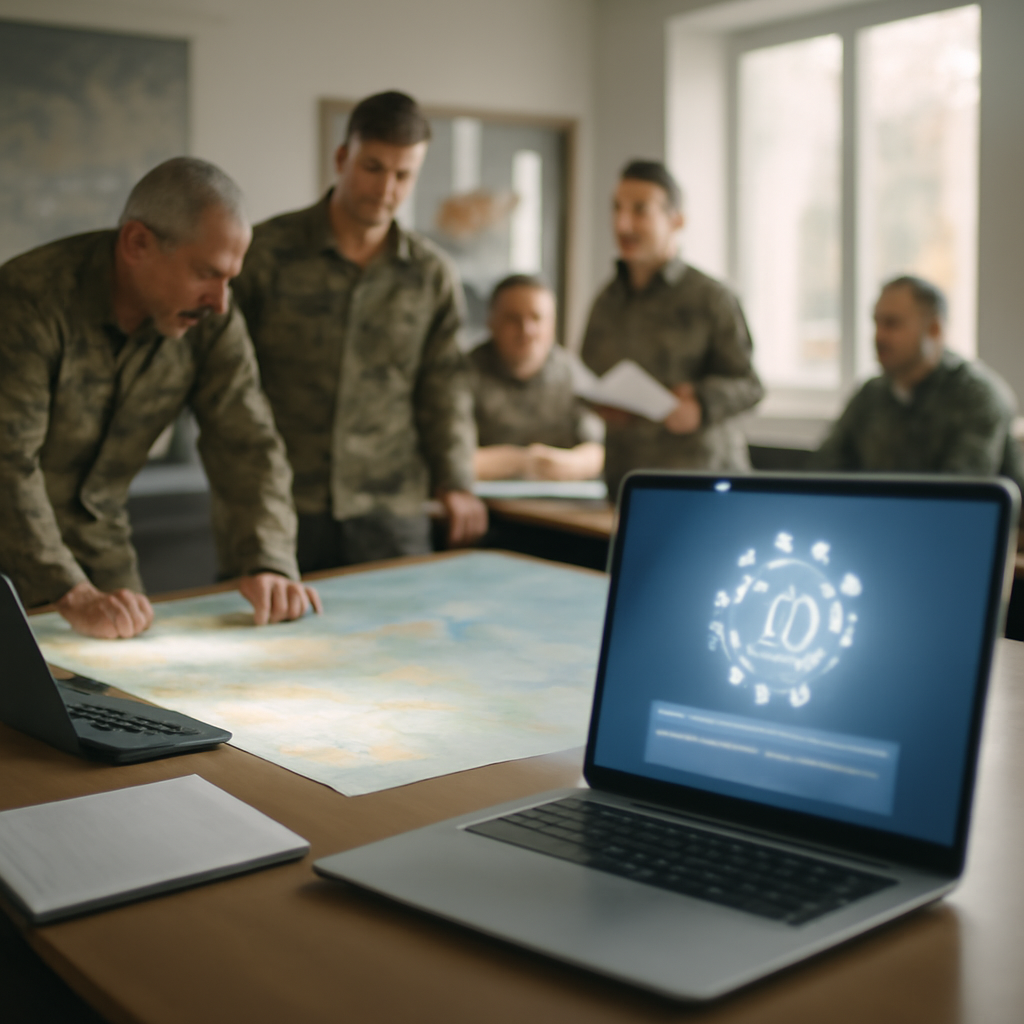
"We didn't use AI for course of action development. Large language models don’t really understand three-dimensional space." Col. Ryan Bell spoke plainly about the limits and the gains after a year of putting artificial intelligence into the 3rd Mobile Brigade Combat Team's planning process.
Col. Ryan Bell's experiment with AI in the 3rd Mobile Brigade Combat Team
The 3rd Mobile Brigade Combat Team of the 101st Airborne division spent the last year "ingraining AI into all staff sections," Col. Ryan Bell told reporters. The unit trained large language models on joint, Army and division doctrine so each staff section could operate its own bots to better understand the operating environment and to respond more quickly during planning and orders development.
How large language models sped mission analysis and orders development
Bell reported concrete speed gains. By using AI, his brigade could take operations orders received from division and "push a brigade warning order out in under half an hour." That acceleration allowed staff to devote more time to war‑gaming. In one defensive scenario, battalions completed planning cycles 72 hours ahead of the typical timeline, enabling them to refine rehearsals and add obstacles to their defenses before the opposing force committed reconnaissance.

This site is the portfolio.
OSINTSights runs on Cloudflare Workers, D1, R2, and Vectorize, with an AI pipeline on Hetzner ARM. Nubivance designed, built, and operates it. We do the same for clients.
See what we buildWhere AI fell short: course of action development and three-dimensional planning
Despite those gains, Bell said the brigade deliberately avoided using AI for course of action development. "Large language models don’t really understand three-dimensional space. And so they’re not good for developing course of action," he said, stressing that human expertise remains essential: "That’s where you need the expertise of a skilled staff to understand the art of war fighting to plan the operation." While Bell noted AI could be used to test courses of action ahead of contact, he drew a clear line between testing/support and primary development.
Drones, sensors and intelligence processing: scale and tempo
In a ten‑day rotation at the Joint Readiness Training Center at Fort Polk, La., drone sensors and reports generated "over 25,000 spot reports" for the brigade's intelligence section. All of those reports were processed using AI, a workflow Bell credited with helping "make sense for the battlefield and respond faster than Geronimo." He described a defensive fight in which Geronimo observed "three chemical attacks and then using their robots to attempt to breach," and said the AI-aided tempo helped the brigade hold despite that observation and probing.
What this means for battalions, brigade staff, and AI developers
- Battalions and companies: Faster, earlier orders (the reported 72-hour head start) gave lower echelons more time to rehearse, refine obstacles and build layered defenses—concrete benefits Bell tied to survivability and tempo.
- Brigade staff and intelligence sections: AI reduced processing load and sped mission analysis, allowing staffs to push warning orders quickly and concentrate human effort on war‑gaming and decisionmaking tasks that require three‑dimensional understanding.
- AI developers and tool builders: Bell's experience frames clear product requirements—support mission analysis, accelerate orders, and process large volumes of sensor data—while marking course of action generation in complex, spatially layered environments as a capability gap.
Col. Bell's account is not an argument for wholesale replacement of skilled planners with models, nor is it a rejection of AI across the board. It is a practical inventory: where models accelerate staff work, where they test plans, and where the art of planning still depends on human expertise to visualize and decide in three dimensions. After a year of integration and an April rotation at Fort Polk that produced tangible timelines and a flood of sensor reports, the brigade's lesson is straightforward and operationally focused—use AI where it buys time and clarity, not where it must imagine the battlefield.
Source: Breaking Defense — Army Air Assault brigade found AI tools ill-suited to tactical planning