"Providing core software applications is a critical next step. It provides a foundation that can be rapidly scaled and trained with continuity across the force,” Joseph Welch, portfolio acquisition executive Command and Control (C2)/Counter C2, said in the Army release announcing the awards.
The nine awardees and $93.6 million in application contracts
The Army announced it has awarded nine companies contracts collectively totaling around $93.6 million to supply applications in support of the Next Generation Command and Control (NGC2) effort. The companies named in the announcement are General Dynamics Mission Systems, Air Space Intelligence Federal, Immersive Wisdom, LMI Consulting, Mente Systems, Stilman Advanced Strategies, Onebrief, Rune Technologies, and AIR (formerly Govini). Each contract covers an initial one-year period.
What the Army says the applications will do
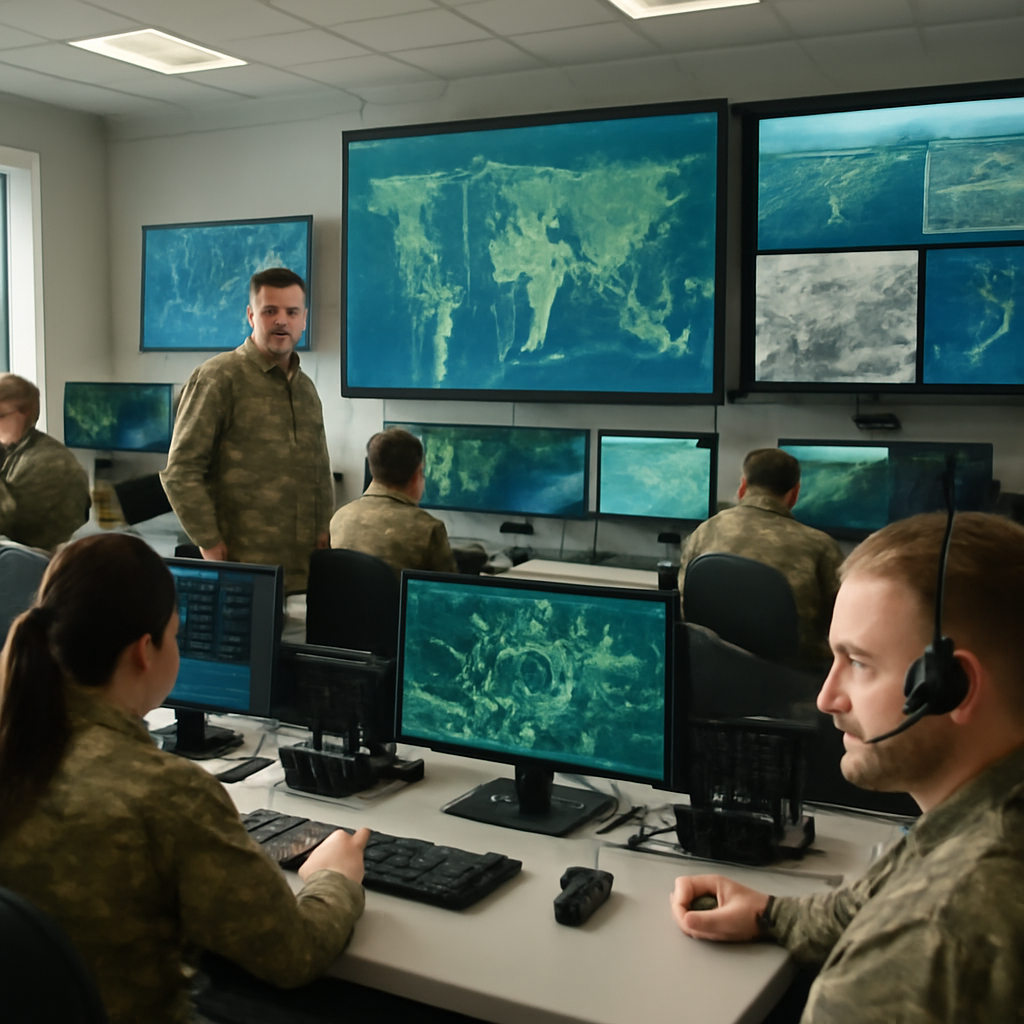
An Army spokesperson declined to provide details about the specific tasks the applications will perform, citing security concerns, but told Breaking Defense that generally the apps "will allow soldiers and commanders conduct faster and more integrated planning, synchronization, operational modeling and course of action analysis; airspace management and deconfliction, as well as sustainment management and decision support." The announcement frames these applications as enabling “critical software capabilities” for NGC2.

Audit-ready is a season. It shouldn't be.
Evidence in spreadsheets, controls drifting between audits, frameworks multiplying on flat headcount. Nubivance runs continuous compliance on Rapid7 Cyber GRC - SOC 2, HIPAA, ISO 27001, PCI, CMMC.
End the scrambleI Corps in the Pacific: the first fielding organization
The contracts are tied to delivery of capabilities to I Corps in the Pacific, which the Army identified as the first fielding organization for NGC2. The release frames the applications as part of the service’s ongoing effort to field NGC2 "as it scales to the corps level." The one-year application awards are presented as a foundational set of software pieces that can be trained and scaled across the force, according to Joseph Welch’s statement.
How the app awards sit alongside the data and AI layer agreements
The app awards were announced against the backdrop of earlier, higher-profile NGC2 layer awards. In June the Army announced Anduril would lead the common data layer baseline with support from Palantir and Raft; at the time a value was not given because the award was made under an enterprise licensing agreement with a 10-year, $20 billion ceiling. Anduril later disclosed an “initial base period valued at $162.8 million, with options that could bring its total value to $1.8 billion over five years.”
In August, Striveworks was selected to lead the artificial intelligence layer. Contract values for that award were not disclosed at the time; a Striveworks spokesperson later told Breaking Defense the company “will soon announce a new $200 million award on top of $70 million it received previously.” The company will also provide its Chariot suite of software platforms, which, the company says, in part “ensure AI models continue working in changing environments, allowing soldiers to turn vast amounts of information into actionable decisions in minutes.”
The Army stated it will continue to onboard relevant technologies for the NGC2 architecture through its commercial solutions opening, indicating a modular, layered approach that pairs the newly announced applications with the data and AI layers.
What this means for technologists, procurement leaders, and I Corps
- Technologists and security teams: will be tasked with integrating apps from multiple vendors with an existing common data layer and an AI layer — both of which already have named lead providers — while working under the security constraints the Army cited when declining to detail specific app tasks.
- Procurement leaders: will operate inside the Army’s commercial solutions opening model, continuing to award and onboard software components at multiple layers (applications, data, AI) as NGC2 scales and as companies announce follow-on funding streams and options.
- I Corps (the first fielding organization): will receive these applications first and serve as the initial operational environment where the Army expects the software to be trained and scaled “with continuity across the force,” as described by Joseph Welch.
The Army’s move to distribute nearly $94 million in application work to nine vendors is one visible step in assembling a layered NGC2 architecture that already includes a separately funded common data baseline and an AI layer. The immediate next step named in the announcement is delivery to I Corps in the Pacific; beyond that, the Army’s stated approach — using a commercial solutions opening to bring in technologies as needed — will determine how these discrete awards stitch together into the corps-level capability Welch described. The Army declined to disclose the specific tasks the apps will perform, leaving operational detail limited to the general functions the spokesperson outlined.