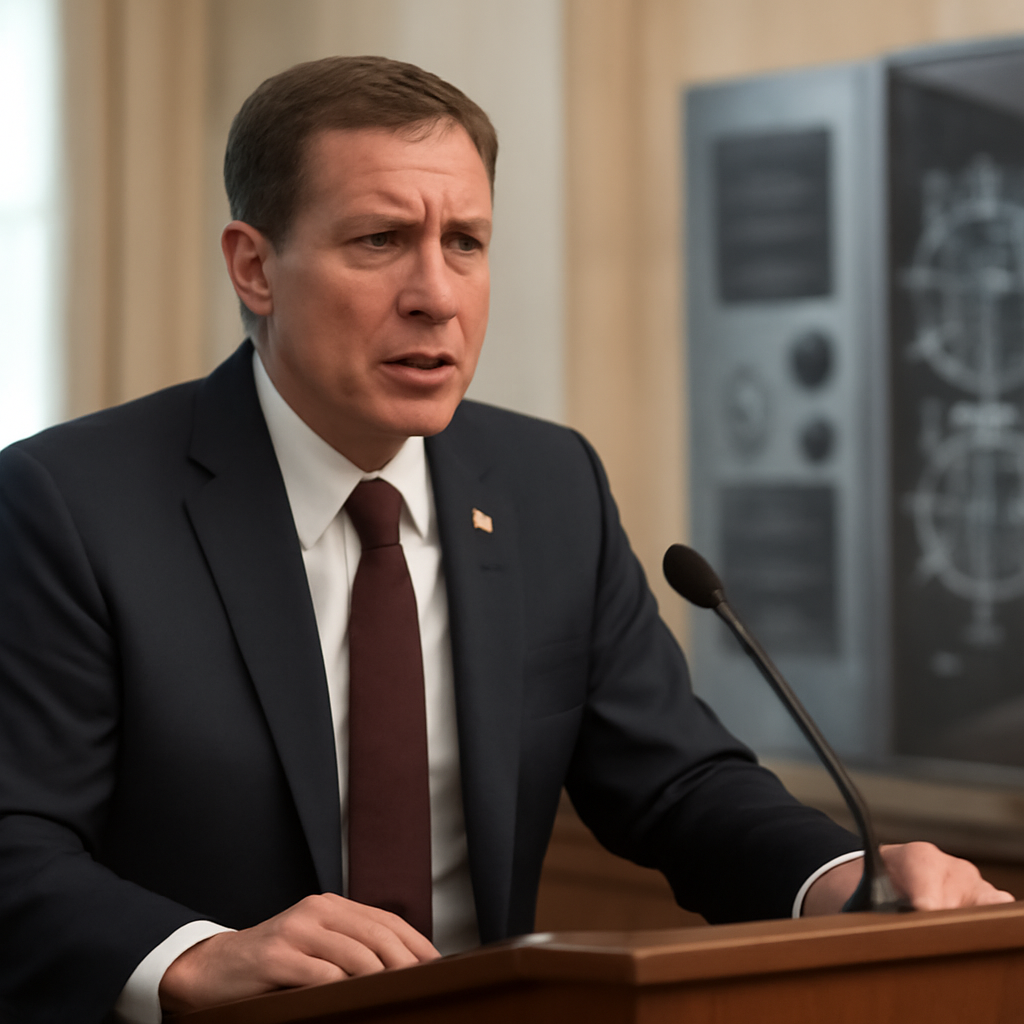
“We aren't spending enough time thinking about the implications of recursive self-improvement,” James Baker said, framing the danger he believes intelligent systems pose to existing institutions.
James Baker joins Anthropic as “strategist-in-residence”
James Baker, who led the Defense Department’s Office of Net Assessment from 2015 to 2025, has taken a role at AI company Anthropic as a “strategist-in-residence.” Anthropic announced Baker will lead analysis of how artificial intelligence is reshaping U.S. institutions and the trajectory of U.S.–China competition. Baker told Defense One that his move reflects a judgment that adapting to AI is a “multi-decade structural—even civilizational—problem.”
ONA’s lineage: Andrew Marshall, forecasting, and a 2016 study
The Office of Net Assessment (ONA) was established in 1973 by Andrew Marshall and long operated as what Defense One describes as the “Pentagon’s Think Tank.” The office took a data-driven, “system-of-systems” approach to forecasting long-term trends across human activity — for example, how technology development could reshape military affairs and labor. ONA historically warned that information technology would speed warfare and broaden access to precise cyber and electromagnetic effects, prompting rethinking of force structure and acquisition reform.
In its last decade ONA focused increasing attention on artificial intelligence. A 2016 summary study — which informed a 2017 unclassified Belfer Center examination — described a “Cambrian explosion” in robotics and AI that would make warfare cheaper and faster and undercut the advantage of costly “exquisite platforms,” naming $90 million jets as an example. Defense One notes that trend’s apparent manifestation today in Ukraine, where a smaller force has used drones to strike expensive Russian naval and air-defense assets.

This site is the portfolio.
OSINTSights runs on Cloudflare Workers, D1, R2, and Vectorize, with an AI pipeline on Hetzner ARM. Nubivance designed, built, and operates it. We do the same for clients.
See what we buildDefense Department reorganization, ONA’s closure, and partial reinstatement
ONA’s future has been unsettled. Baker left the office in 2025 after it was temporarily closed by the Trump administration. The Defense Department shuttered ONA last March, saying the move refocused personnel as “another step in a series of cuts to Defense Department basic research beyond applications for specific weapons and technologies.” A Pentagon spokesperson said the reorganization was intended to let the department better address “pressing national security challenges,” but offered no further explanation. In October the department reinstated a downgraded version of ONA.
Anthropic, Mythos, and the White House supply-chain designation
This March the White House designated Anthropic a supply-chain risk, a move the source links to a disagreement between current Defense Department leadership and the company over safe deployment of Anthropic models. In April Anthropic said it would limit release of a new tool called Mythos to a handful of federal agencies and corporate partners to help the company surface vulnerabilities it might otherwise miss. Defense One reports that the number of new vulnerabilities logged in the National Vulnerability Database nearly doubled “this month.”
What this means for technologists, policymakers, and military leaders
- Technologists and security teams: Anthropic’s limited Mythos rollout and the spike in NVD entries signal active discovery and disclosure of vulnerabilities; engineering teams will face pressure to validate models and tools with tightly scoped pilots rather than broad public releases.
- Policymakers and regulators: The White House supply-chain designation and the DoD’s reorganization underline institutional friction over how to treat high-capability AI providers; officials will weigh whether existing organizational structures can handle “recursive self-improvement” risks Baker highlighted.
- Military leaders and defense planners: ONA’s historical role in anticipating structural shifts — and its recent fluctuation between closure, downgrade, and partial reinstatement — illustrates tension between long-range assessment and nearer-term program priorities as AI changes the calculus of force structure and acquisition.
Baker’s move to Anthropic cements a striking intersection: a strategist steeped in decades of defense forecasting will now work inside a major AI firm that faces scrutiny from the White House and the Defense Department. He frames the central challenge in stark terms — not a short-term technical problem but a multi-decade, institutional test driven by the possibility of systems that can improve themselves faster than their creators expect. Whether that thesis will prompt new public-private methods for stress-testing models, revive sustained investment in long-range assessment inside government, or reshape how agencies classify and manage supply-chain risk is a question the facts in this story leave squarely on the table.