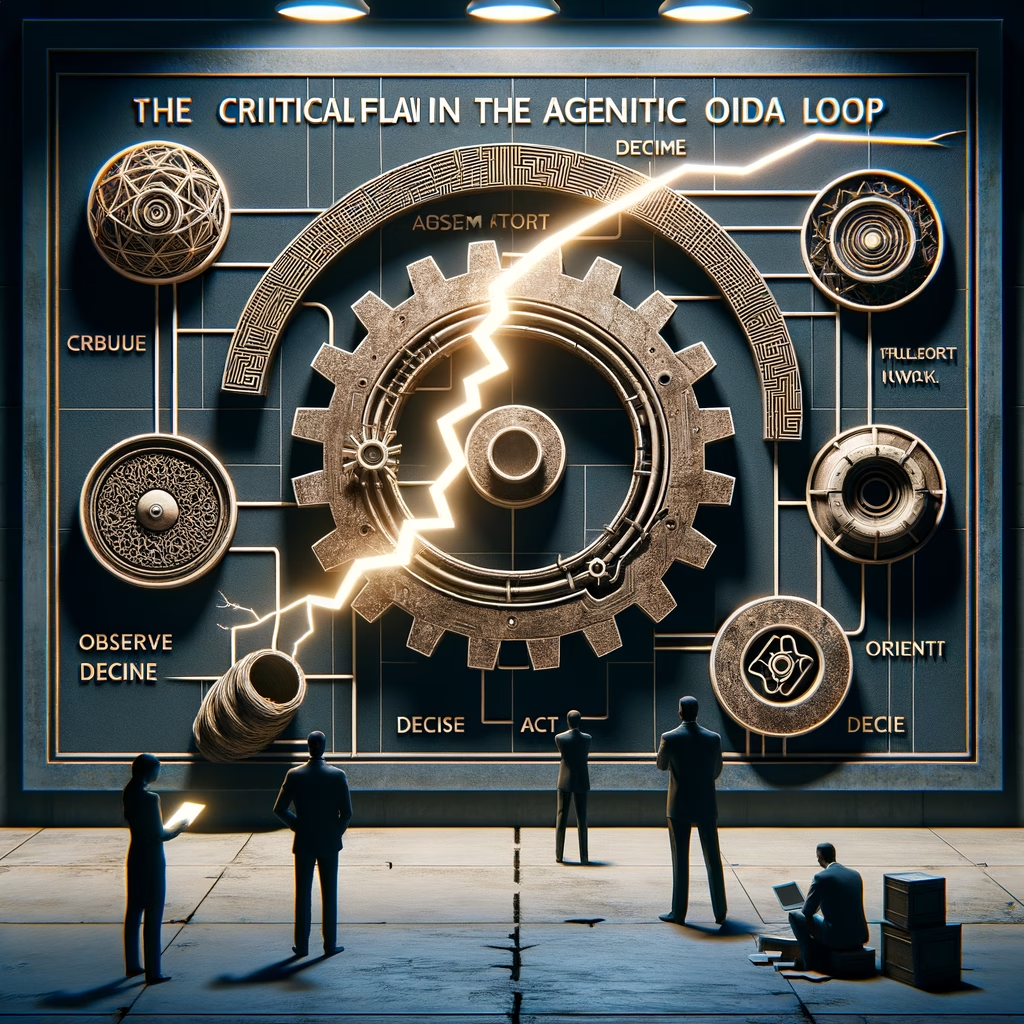
<p“When the instrument you trust to tell you the truth begins to lie, whom do you believe?” That is the question hovering over a new generation of autonomous systems — agentic AIs that observe, orient, decide and act in loops borrowed from Colonel John Boyd’s wartime framework. The promise is tempting: faster decisions, automated workflows, and scaled productivity. The peril is subtle and singular: the OODA loop assumes reliable inputs and meaningful orientation; agentic AIs do not always get either. The result is an exclusive, critical flaw at the heart of their decision cycle — untrustworthy observations and orientation that can cascade into catastrophic action.
Boyd’s OODA loop — Observe, Orient, Decide, Act — was developed for fighter pilots to outpace adversaries in dynamic engagements. Today, technologists apply that same iterative model to software agents that chain reasoning and tools to pursue goals across systems. But unlike pilots, these agents take in data that may be corrupted, incomplete, or outright adversarial, and they form orientations — internal models of the world — that can be brittle, biased, or manipulated. When an agent’s inputs and orientation are untrustworthy, every subsequent decision and action inherits the error, magnifying harm at machine speed.
Security researchers and practitioners describe concrete manifestations. An agent with broad API rights could exfiltrate, modify, or erase data while disguising malicious behavior as legitimate automation; an attacker who hijacks an agent can escalate a breach into an automated, multi-step campaign faster than human responders can react. These systems expand the attack surface, create new lateral-movement pathways, and produce failures that are harder to detect, diagnose, and remediate than conventional incidents .
Technologists celebrate agentic systems as logical evolutions of automation: reinforcement learning, advanced planning, and large language models now let systems plan and act in multi-step sequences. For many engineers, that capability answers pressing operational needs — scaling service delivery without linear headcount growth. Yet the same chaining that delivers efficiency also produces opacity. Agentic behavior can be emergent and distributed across services, complicating provenance and auditable explanation, which are essential when outcomes affect people, money or critical infrastructure .
Policymakers face thorny trade-offs. Existing administrative law, incident reporting and liability frameworks presume human decision-makers and traceable reasoning. Agentic systems often produce opaque or distributed explanations, making it difficult to establish accountability or offer meaningful contestability to those harmed by automated decisions. Agencies such as CISA and standards bodies like NIST offer guidance, but regulators must decide whether to graft new obligations onto legacy frameworks or to build rules specific to autonomous decision-making — a task that will shape where and how these systems are allowed to operate in public and private sectors .
Enterprise leaders and security teams are already wrestling with immediate operational challenges: how to provision credentials for machines, how to build immutable audit logs and action provenance, and when to require human sign-off for high-risk operations. Practical mitigations exist, but they carry trade-offs: narrowing agent privileges limits utility; adding human oversight slows throughput; and extensive logging raises privacy and data-management burdens. Still, informed practitioners recommend a layered approach to reduce the core OODA flaw — ensuring integrity of inputs, robustness of orientation, and governance of actions .
From the adversary’s seat, agentic systems are both an attractive target and a potent tool. Compromising an agent that can discover endpoints, traverse services, and execute transactions creates an automation-enabled attacker. Conversely, threat actors may adopt agentic toolchains to orchestrate faster, more complex campaigns with minimal human direction. The prospect of automated offenses and automated defenses locked in iterative loops raises strategic questions about escalation and response times in cyberspace.
The heart of the problem is not that agents act autonomously; it’s that their autonomy rests on fragile epistemology. Three failure modes matter most:
/
Corrupted observation: Inputs come from sensors, APIs, human data entries and other systems — each a vector for deliberate manipulation or accidental skew. Agents that accept such feeds without rigorous validation form false premises.
/
Brittle orientation: Internal models and goals can misinterpret context, amplify bias, or overfit to training artifacts. Once an agent’s “orientation” is wrong, it interprets subsequent observations through a warped lens.
/
Unchecked chaining: Multi-step plans can hide malicious or erroneous substeps inside longer workflows, allowing harmful actions to blend into seemingly legitimate automation until consequences are irreversible.
Mitigation demands rethinking input, processing and output integrity as an integrated system, not as afterthought controls. Recommended technical and governance measures include:
/
Least privilege and microsegmentation for agents: grant narrowly scoped, time-limited capabilities rather than persistent, broad access; automate credential rotation and continuous attestation to shorten compromise windows .
/
Provenance and observability: capture immutable, replayable audit trails of observations, internal state transitions, and action rationales so human operators can reconstruct and contest agent decisions; require human approval gates for high-risk operations .
/
Adversarial testing and red-team exercises: specifically probe for manipulated inputs, goal-injection attacks, and emergent behaviors across chained actions; simulate compromised components and adversarial orientations to validate fail-safes .
/
Policy and procurement controls: embed constraints in contracts and SLAs that limit agent authority, require certification of safety controls, and mandate incident reporting tailored to autonomous actors .
Different stakeholders will judge risk and reward differently. Engineers may accept residual uncertainty for gain in productivity. Security teams will press for conservative limits until robust attestations exist. Regulators will weigh social harms and legal responsibility. And the public — ultimately the most consequential stakeholder — will judge institutions by their ability to offer contestability, transparency and redress when agents err or are exploited .
There is no single technological silver bullet. Formal verification helps in constrained domains, but many real-world environments are too open and heterogeneous for exhaustive proofs. What is clear, however, is that the classic OODA loop assumption of trustworthy inputs and orientation must be replaced with engineering and governance that explicitly protect those layers. Treating observation and orientation as security properties — not merely performance variables — is the essential shift.
In practical terms, that means designing systems so that agents never operate with unchecked authority over critical outcomes; so that their inputs are validated and traceable; and so that their internal reasoning and action histories can be audited and contested. It means aligning incentives across product, security, legal and procurement teams to see agentic authority as a negotiable control, not a convenience. It also means policy makers must move from advisory guidance to enforceable requirements where public risk is high.
We are at a hinge point: agentic AI can be an engine of productivity or a force multiplier for harm. The exclusive critical flaw in the agentic OODA loop — the fragility of observation and orientation — is not an abstract theoretical concern. It is a concrete engineering and governance problem that, if unaddressed, will convert routine automation into a high-velocity avenue for damage. Will society treat the integrity of what machines see and believe with the same seriousness we attach to what people see and believe? The answer will determine whether agentic AIs become tools that augment human judgment or instruments that amplify our blind spots.
Source: https://www.schneier.com/blog/archives/2025/10/agentic-ais-ooda-loop-problem.html



